
Verheerlijking van de Duitse Orde, in het bijzonder van de landcommanderij Alden Biesen
1700
Medium
etching
Dimensions
250; 172
Rights
Public Domain
About this artwork
height 172 mm x width 250 mm
Art Historical Context
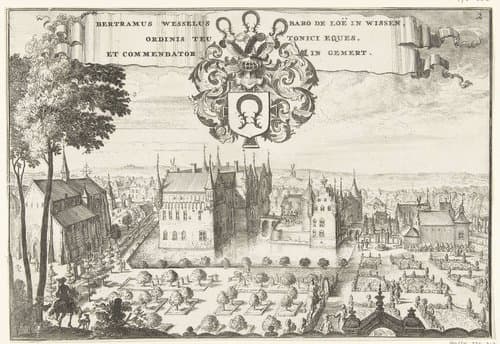
Romeyn de Hooghe, a prolific Dutch Baroque artist renowned for his intricate etchings and satirical works, created *Verheerlijking van de Duitse Orde, in het bijzonder van de landcommanderij Alden Biesen* in 1700. This finely detailed etching, measuring 172 mm high by 250 mm wide, exemplifies de Hooghe's mastery of printmaking, a technique where acid bites into a metal plate to produce sharp, expressive lines ideal for reproducing elaborate scenes. The title translates to "Glorification of the Teutonic Order, Particularly the Land Commandery of Alden Biesen," honoring the medieval Teutonic Knights—a powerful German military order founded during the Crusades. Alden Biesen, located in present-day Belgium, was a key commandery symbolizing the order's enduring influence in the Low Countries. Produced at the dawn of the 18th century, the print likely served as propaganda or commemorative art, celebrating the order's chivalric legacy amid shifting European powers. De Hooghe's dynamic Baroque style, with its swirling compositions and allegorical flourishes, captures grandeur on a modest scale, making such imagery accessible to a wider audience through affordable prints. This work highlights etching's role in preserving cultural and historical narratives, inviting viewers to marvel at the knights' storied past.
About the Artist
Romeyn de Hooghe · 1645–1708
Romeyn de Hooghe (1645-1708) was a Dutch Baroque engraver, draughtsman, and political satirist who became the most prolific and versatile graphic artist of the Dutch Republic in the late seventeenth century. Born in Amsterdam, he rose to become one of early modern Europe's most important printmakers and a pioneering master of political satire. De Hooghe's significance extends far beyond his techn...