
Verheffing van Willem III tot opperbevelhebber van land-en zeemacht
1672
Medium
striking (metalworking)
Dimensions
15.22; 3
Rights
Public Domain
About this artwork
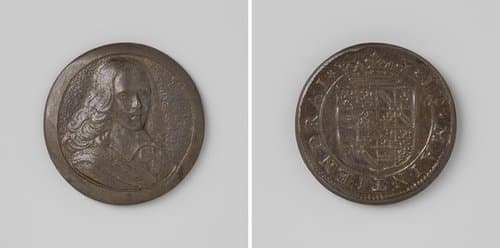
Bronzen penning. Voorzijde: borststuk man. Keerzijde: gekroond wapenschild binnen omschrift.
Art Historical Context
**Verheffing van Willem tot opperbevelhebber land-en zeemacht** (1672) is a finely bronze medal, or *penning*, struck anonymously to celebrate a pivotal moment in Dutch history. Measuring just 3 cm in diameter and weighing .22 grams, this small yet potent artifact features a bust of a man—likely the young William III of Orange—on the obverse, symbolizing leadership and resolve. The reverse displays a crowned coat of armsled by an inscription, evoking royal authority and national pride. Created during the Netherlands' catastrophic "Rampjaar" of 1672, when French, English, and allied forces invaded the Republic, the medal commemorates William III's rapid elevation at age 21 to supreme commander (*opperbevelhebber*) of both land and sea forces. This appointment marked a turning point, rallying the Dutch against overwhelming odds and foreshadowing William's future as stadtholder and later King of England. Such medals served as portable propaganda, distributed to inspire loyalty and morale amid crisis. Struck using precision metalworking techniques, the medal's intricate detailing highlights the era's mastery of die-engraving, where hardened steel dies imprint designs onto softened bronze blanks. Though anonymous, it exemplifies 17th-century Dutch numismatic art, blending portraiture with heraldry to immortalize political upheaval in a durable, intimate form. A testament to resilience, it invites visitors to ponder how even tiny objects can encapsulate a nation's survival.
About the Artist
anonymous
In the vast tapestry of art history, "Anonymous" stands not as a singular individual but as a collective designation for countless unidentified creators whose works have endured across millennia. These artists, spanning prehistoric cave painters to medieval illuminators and folk craftsmen, produced the foundational layers of human visual culture. Prior to the Renaissance, when individual fame emer...