
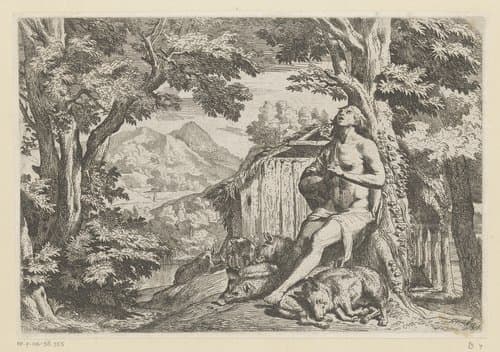
Verloren zoon als zwijnenhoeder
ca. 1621 - 1650
Medium
etching
Dimensions
204; 301
Rights
Public Domain
About this artwork
plaatrand: hoogte 204 mm x breedte 301 mm
Art Historical Context
Behold *Verloren zoon als zwhoeder* (The Prodigal Son as Swined), a poignant etching by the Italian Baroque artist Pietro Testa created around 1621–1650. This work draws from the biblical Parable of the Prodig Son (Luke 15:11–32), capturing the moment of the wayward son's deepest humiliation: tending pigs in squalor, a stark symbol of his fall from grace. Testa, a master engraver from Lucca known for his intricate drawings and prints, infused Baroque drama into religious narratives, emphasizing human suffering and redemption. Etched on a plate measuring 204 mm high by 301 mm wide, the artwork showcases Testa's virtuoso technique. Etching, involving acid biting into a metal plate to create fluid lines and rich tonal contrasts, allowed him to evoke texture—from the swine's coarse hides to the son's ragged despair—with remarkable precision. This medium was revolutionary in the 17th century, making high-quality reproductions accessible beyond paintings, bridging elite art with broader audiences. Testa's print exemplifies Baroque printmaking's cultural role, blending spiritual depth with technical innovation. It invites visitors to reflect on themes of folly, repentance, and mercy, much like the era's Counter-Reformation art. A gem for etching enthusiasts, it highlights how Testa rivaled contemporaries like Rembrandt in expressive power.
About the Artist
Pietro Testa · 1612–1650
Pietro Testa was born in Lucca in 1612 and, in accordance with the conventions of Italian artistic training, made his way to Rome while still young. There he studied under two of the leading painters of the early seventeenth century: Domenichino, from whom he absorbed a taste for classical restraint and narrative clarity, and Pietro da Cortona, whose more exuberant Baroque manner offered a contras...