
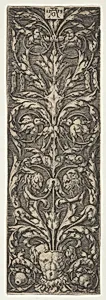
Vertical Panel with Inhabited Candelabrum Rising from a Cuirass
Medium
Engraving
Dimensions
Sheet: 5 5/16 × 1 3/4 in. (13.5 × 4.4 cm)
Classification
Prints|Ornament & Architecture
Department
Drawings and Prints
Museum
Metropolitan Museum of Art, New York, NY
Credit
Harris Brisbane Dick Fund, 1926
Accession Number
27.23.80
Rights
Public Domain
Tags
Art Historical Context
Heinrich Aldegrever, a master engraver from the German and one of the "Little Masters" known for their finely detailed small-scale prints, created *Vertical Panel with Inhabitedelabrum Rising from Cuirass* in 1553. This delicate engraving, measuring just 5 5/16 × 1 3/4 inches, exemplifies the precision of intaglio printmaking, where acid-etched lines on a metal plate capture intricate designs with remarkable clarity. Produced during a time when Northern European artists eagerly adopted Italian Renaissance motifs, Aldegrever's work served as a pattern book for goldsmiths, armorers, and decorators. The composition features a fantastical candelabrum—a tall, ornate stand—emerging from a cuirass, or breastplate armor, entwined with vines and populated by grotesque figures. These whimsical, hybrid creatures draw from ancient Roman decorations rediscovered in the Renaissance, blending military symbolism with playful fantasy. Such "inhabited" ornaments reflected the era's fascination with classical antiquity and nature's abundance, transforming functional armor into a canvas for elaborate grotesques. Housed in the Metropolitan Museum of Art's Drawings and Prints department, this print highlights the cultural role of engravings in disseminating ornamental ideas across Europe, influencing everything from jewelry to architecture. Visitors will appreciate its tiny scale, which invites close inspection of Aldegrever's virtuoso linework.
About the Artist
Heinrich Aldegrever · 1502–1561
Heinrich Aldegrever, born in 1502 in Paderborn, Westphalia, to parents Herman and Katherine Trippenmeker—a family of clog-makers known by the dialect name Trippenmecker—emerged as a multifaceted artist in the German Renaissance. His early training remains undocumented, though he likely apprenticed in a Soest goldsmith's workshop after relocating there around 1525, where he joined the painters' gui...