
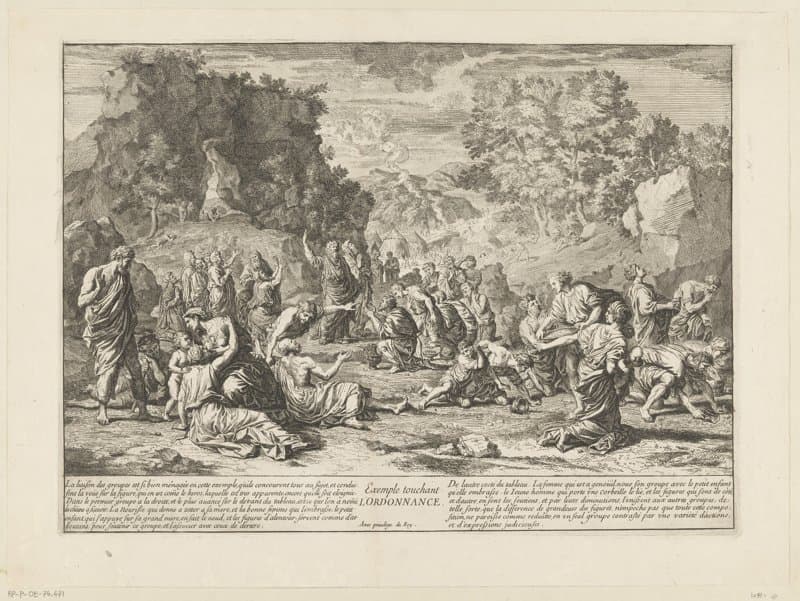
Verzamelen van het manna in de woestijn
1639 - 1695
Medium
etching
Dimensions
449; 325
Rights
Public Domain
About this artwork
plaatrand: hoogte 325 mm x breedte 449 mm
Art Historical Context
Henri Testelin's *Verzamelen van het manna in deestijn* (Gathering of the Manna the Desert), an etching from the late 17th century, a pivotal biblical moment from the Book of Exodus. Here, the Israelites collect the miraculous manna provided by God during their wilderness wanderings, symbolizing divine providence and sustenance amid hardship. As a French artist active between 1639 and 1695, Testelin drew from the era's deep religious devotion, blending narrative storytelling with the grandeur of Baroque sensibilities. Rendered in etching—a meticulous intaglio technique where acid etches lines into a metal plate—this work measures 325 mm high by 449 mm wide (plate mark). Etching allowed Testelin to achieve fine, expressive lines and tonal depth, ideal for distributing intricate religious scenes to a wider audience beyond oil paintings. Popular in 17th-century Europe, such prints served both devotional and educational purposes in homes and churches. This piece reflects the cultural importance of biblical imagery in French art during Louis XIV's reign, when printmaking flourished as an accessible medium for moral and spiritual reflection. Visitors will appreciate its delicate craftsmanship, inviting contemplation of faith and survival in a vast, arid landscape.
About the Artist
Henri Testelin · 1616–1695
Henri Testelin (1616–1695) was a French painter, art theorist, and institutional organizer whose contributions to the Académie Royale de Peinture et de Sculpture proved as significant as his paintings. Born in Paris in 1616 as the son of Gilles Testelin, painter to King Louis XIII, Henri became one of the founding members of the Académie Royale in 1648 and served as its secretary from 1650, playin...