
Vessel in Form of Two Pumas
100 BCE–500 CE
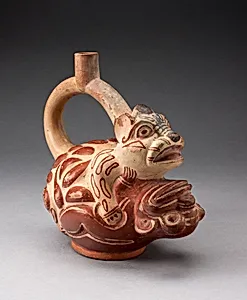
Medium
Ceramic and pigment
Dimensions
19.7 × 20.3 cm (7 3/4 × 8 in.)
Classification
earthenware
Department
Arts of the Americas
Museum
Art Institute of Chicago
Accession Number
91595
Rights
Public Domain
Art Historical Context
This captivating ceramic vessel, created by the Moche people of northern Peru between 100 BCE and 500 CE, takes the form of two pumas. Crafted from earthenware and enhanced with pigment, the piece measures roughly 8 inches across and showcases the exceptional skill of Moche potters, who were renowned throughout the ancient Andes for their naturalistic modeling and decorative techniques. The Moche civilization flourished along Peru’s north coast, building a sophisticated society with advanced irrigation, monumental architecture, and a rich artistic tradition. Animals such as pumas—powerful predators of the Andean landscape—appear frequently in their ceramics, likely carrying symbolic associations with strength, agility, or the spiritual world. Vessels like this one served both practical and ceremonial roles, reflecting the high status of pottery in Moche culture. Today this work, housed in the Art Institute of Chicago’s Arts of the Americas collection, offers visitors a vivid window into pre-Columbian creativity. Its compact yet expressive form invites us to appreciate how the Moche transformed everyday materials into objects of lasting beauty and cultural meaning.
About the Artist
Moche
The Moche artists flourished between approximately 100 and 800 CE along the northern coast of Peru, in valleys such as Moche, Chicama, and Virú, creating a profound body of work in ceramics, metalwork, and monumental architecture that defined their stratified society. Centered around sites like Huaca del Sol and Huaca de la Luna near modern Trujillo, these anonymous artisans operated in specialize...