
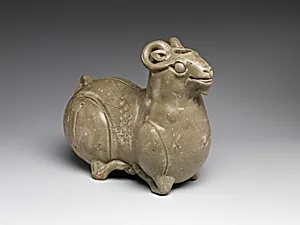
六朝 越窯青瓷臥羊|Vessel in the shape of a kneeling ram
Unknown Artist
ca. 4th century
Medium
Stoneware with celadon glaze (Yue ware)
Dimensions
L. 15.2 cm (6.2 in.)
Classification
Ceramics
Culture & Period
China · Six Dynasties (220–589)
Department
Asian Art
Museum
Metropolitan Museum of Art, New York, NY
Credit
Gift of Stanley Herzman, in memory of Adele Herzman, 1991
Accession Number
1991.253.2
Rights
Public Domain
Tags
Art Historical Context
This charming celadon-glazed stoneware vessel, shaped as a kneeling ram, hails from China's Six Dynasties period (ca. 4th century), a turbulent era of political fragmentation following the Han dynasty's fall. Crafted at the renowned Yue kilns in modern-day Zhejiang province, it exemplifies early Yue ware—one of the earliest high-fired stonewares with a signature pale green celadon glaze. just 15.2 cm long, this intimate piece likely served as a ritual or decorative container, its naturalistic form capturing the ram's serene posture with subtle modeling and a glossy, jade-like surface that mimicked prized imperial jades. Yue ware celadons were revolutionary for their time, achieving a translucent, crackled glaze through wood-ash fluxing in dragon kilns, techniques that influenced later Song dynasty masterpieces. Produced during the Eastern Wu kingdom's cultural flourishing, these ceramics bridged utilitarian craft and artistry, symbolizing prosperity and auspiciousness—rams evoked strength and abundance in Chinese lore. Today, gifted to the Metropolitan Museum of Art in 1991, this ram vessel invites us to marvel at ancient ingenuity, where everyday clay transformed into objects of ethereal beauty, bridging the mortal and divine.