
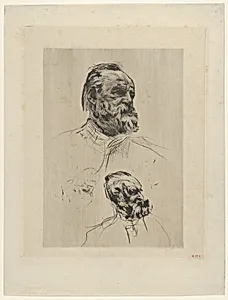
Victor Hugo (three-quarter view)
Medium
Drypoint on laid paper; second state of eight
Dimensions
Image: 7 5/8 x 5 7/16 in. (19.4 x 13.8 cm) Plate: 8 7/8 x 6 15/16 in. (22.5 x 17.6 cm) Sheet: 11 1/4 x 8 1/2 in. (28.5 x 21.6 cm)
Classification
Prints
Department
Drawings and Prints
Museum
Metropolitan Museum of Art, New York, NY
Credit
Rogers Fund, 1916
Accession Number
16.37.2
Rights
Public Domain
Tags
Art Historical Context
In 1885, master sculptor Auguste Rodin turned his hand to printmaking to capture the commanding presence of Victor Hugo,'s literary titan behind *Les Misérables* andThe Hunchback of Notre-Dame*. This drypoint portrait, showing Hugo in a three-quarter view reveals the poet's intense gaze and tousled hair, rendered with Rodin's characteristic vigor. Produced during Hugo's later years—after his triumphant return from political exile— the work immortalizes a cultural icon whose Romantic writings championed liberty and social justice. Drypoint, an intimate intaglio technique, allowed Rodin to scratch directly into the copper plate, raising a soft burr that yields velvety, expressive lines full of texture and depth. This is the second state of eight, meaning Rodin refined the plate through multiple iterations, burnishing and reworking areas for heightened drama. Printed on laid paper, a traditional support with visible chain lines, the image measures a modest 7⅝ × 5⅞ inches, inviting close contemplation of its tactile richness. Housed in The Metropolitan Museum of Art's Drawings and Prints department (Rogers Fund, 1916), this print exemplifies Rodin's versatility beyond bronze, bridging sculpture's monumentality with print's immediacy. For visitors, it's a window into 19th-century France, where art and literature converged to celebrate humanism.
About the Artist
Auguste Rodin|Victor Hugo · 1840–1917
François Auguste René Rodin (1840-1917) stands as the founder of modern sculpture, transforming the art form from academic tradition into expressive modernism. Born into a working-class Parisian family, Rodin faced early rejection, failing three times to gain admission to the prestigious École des Beaux-Arts. This setback forced him to work as a craftsman for nearly two decades, though his 1875 tr...