
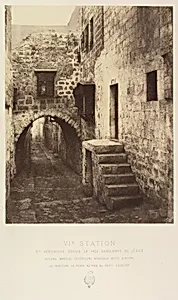
VIe Station. Ste Véronique essuie la face sanglante de Jésus. Aucune marque extérieure n'indique cette station. La tradition la place au pied du petit escalier
1860 or later
Medium
Albumen silver print from paper negative
Dimensions
Image: 11 in. × 8 7/16 in. (28 × 21.5 cm) Mount: 17 15/16 × 23 1/4 in. (45.5 × 59 cm)
Classification
Photographs
Department
Photographs
Museum
Metropolitan Museum of Art, New York, NY
Credit
Gilman Collection, Gift of The Howard Gilman Foundation, 2005
Accession Number
2005.100.500.3 (36)
Rights
Public Domain
Tags
Art Historical Context
This poignant albumen silver print captures the Sixth Station of the Cross along Jerusalem's Via Dolorosa, a sacred path pilgrims have followed since medieval times to retrace Christ's journey to Calvary. Titled *VIe Station. Steronique essuie la facelante de Jésus*Sixth Station: St. Veronica wipes the face of Jesus"), it the site at the foot of a small, marked more by tradition than any visible inscription. The image highlights architectural elements like arches and stairs, evoking the quiet devotion of this holy spot amid the ancient city's stone passages. Created by Louis de Clercq in collaboration with H. Jannin, J. Blondeau, and Antonin around 1860 or later, the photograph exemplifies early travel photography's power to document distant pilgrimage sites for European audiences hungry for biblical authenticity. The albumen process, printing from a paper negative onto salted paper coated with egg white, yielded rich tones and sharp details ideal for architectural subjects, making remote sacred spaces feel vividly present. Part of the Metropolitan Museum of Art's Gilman Collection, this work underscores photography's role in 19th-century visual piety, bridging art, faith, and exploration. Visitors today can appreciate how it freezes a timeless ritual in luminous clarity.