
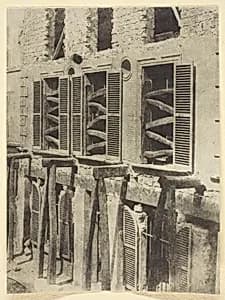
Vieille Maison en Restauration
1842/50, printed 1965
Medium
Gelatin silver print, No. 13 from the portfolio "Bayard: XXV Calotypes, 1842-1850" (1965)
Dimensions
Image/paper/mount: 23 × 17.2 cm (9 1/16 × 6 13/16 in.)
Classification
photographic process
Department
Photography and Media
Museum
Art Institute of Chicago
Accession Number
23784
Rights
Public Domain
Art Historical Context
Hippolyte Bayard, a pioneering French photographer, created “Vieille Maison en Restauration” during the formative years of the medium, between 1842 and 1850. Working at a time when photography was still experimental, Bayard explored the calotype process—an early negative-positive technique on paper that allowed for multiple prints. The scene of an aging house undergoing restoration reflects the period’s growing interest in documenting architectural heritage amid rapid urban change in nineteenth-century France. This gelatin silver print, produced in 1965 as part of the portfolio “Bayard: XXV Calotypes,” brings one of Bayard’s original paper negatives to modern audiences. Its modest scale, roughly 9 by 7 inches, emphasizes intimate detail over grandeur, inviting viewers to appreciate the subtle textures of weathered stone and scaffolding. Today housed in the Art Institute of Chicago’s Photography and Media department, the work underscores Bayard’s quiet yet vital role in shaping photography as both a documentary tool and an artistic practice.
About the Artist
Hippolyte Bayard · 1801–1887
Hippolyte Bayard (1801–1887) was a French civil servant and artist who holds a remarkable, if bittersweet, place in the history of photography: he was one of the independent inventors of the photographic process in the late 1830s, developing his own direct positive paper print method at virtually the same moment that Louis Daguerre and William Henry Fox Talbot were arriving at their own solutions ...