
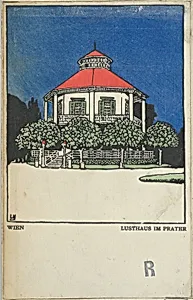
Vienna: "Pleasure Pavilion" in the Prater (Wien: Lusthaus im Prater)
Medium
Color lithograph
Dimensions
Sheet: 5 1/2 × 3 9/16 in. (14 × 9 cm)
Classification
Prints
Department
Drawings and Prints
Museum
Metropolitan Museum of Art, New York, NY
Credit
Museum Accession, transferred from the Library
Accession Number
WW.135
Rights
Public Domain
Tags
Art Historical Context
This charming color lithograph by Urban Janke, produced under the auspices of the Wiener Werkstätte in1908, captures the "Pleasure Pavilion" (Lusthaus) in Vienna's Pr park. The Prater, a beloved green expanse since the 18th century, evolved from an imperial hunting ground into a vibrant leisure destination with amusement rides and pavilions like the Lusthaus—a historic timber-framed structure dating to 1784, famed for its role in Viennese social life. Janke's compact print (just 5½ × 3⅜ inches) invites viewers into this idyllic scene of architecture framed by lush trees, evoking the city's blend of nature and urban delight. As a product of the Wiener Werkstätte, a pioneering design collective founded in 1903 by artists like Josef Hoffmann, this work exemplifies the group's commitment to Gesamtkunstwerk—integrating fine art into everyday objects. Color lithography, a technique perfected in the fin-de-siècle poster boom, allowed Janke to layer vibrant hues with crisp lines, characteristic of Vienna's Jugendstil (Art Nouveau) aesthetic. These small-scale prints often served as postcards or promotional ephemera, democratizing high design. Held in the Metropolitan Museum of Art's Drawings and Prints department, this piece highlights early 20th-century Vienna's cultural effervescence, bridging historic landmarks with modern graphic innovation—a perfect snapshot for visitors strolling the Met's galleries.
About the Artist
Urban Janke|Wiener Werkstätte (Austrian| ) · 1887 | –1914 |
Austrian, Blottendorf/Vienna, 1887–1914|