
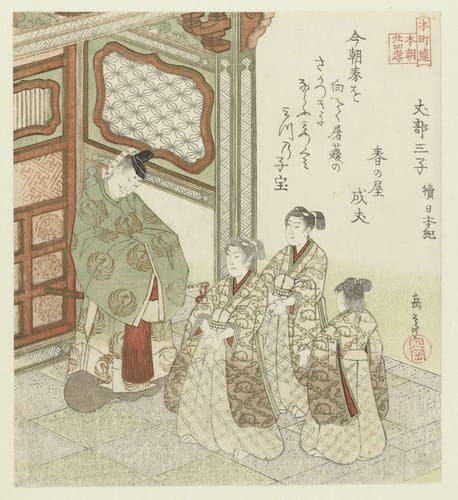
Vierentwintig Japanse voorbeelden van kinderlijke gehoorzaamheid voor de Honchôren
ca. 1821
Medium
nishikie, with metallic pigments
Dimensions
181; 200
Rights
Public Domain
About this artwork
height 200 mm x width 181 mm
Art Historical Context
Visitors to our virtual museum will delight in *Vierentwintigse voorbeelden van kinder gehoorzaamheid voor Honchôren* (Twenty-Four Japanese Examples of Childlike Obedience the Honchôren a exquisite nishikie wood print by Yashima Gutei, created around 1821. Measuring just 200 mm high by 181 mm wide, this compact gem exemplifies the intimate scale of surimono—luxurious, privately commissioned prints popular among poetry circles in late Edo-period Japan. Gakutei, a master of the Kamigata (Kyoto-Osaka) ukiyo-e tradition, was renowned for his refined figure studies and poetic illustrations, often blending artistry with moral themes. The title hints at a series celebrating filial piety and obedience, virtues central to Confucian-influenced Japanese culture, tailored for the Honchôren poetry group. Nishikie, or "brocade pictures," refers to vibrant, multi-color woodblock printing, elevated here by metallic pigments like gold or mica that catch the light, mimicking opulent textiles. This technique underscored the print's status as a high-end New Year's gift or club memento, showcasing Gakutei's skill in delicate linework and harmonious composition. Culturally, such works preserved ethical tales amid Japan's isolationist era, offering subtle social commentary. Gakutei's print invites reflection on timeless family bonds, its shimmering surface a testament to ukiyo-e's innovative beauty. (198 words)
About the Artist
Yashima Gakutei · 1786–1868
Yashima Gakutei (c. 1786–1868), born in Osaka as the illegitimate son of a Tokugawa shogunate samurai named Hirata, adopted the name from his mother's subsequent marriage into the Yashima clan. Little is documented about his early years beyond these familial ties, but he pursued artistic training under the esteemed ukiyo-e masters Totoya Hokkei and Katsushika Hokusai, absorbing their precision in ...