
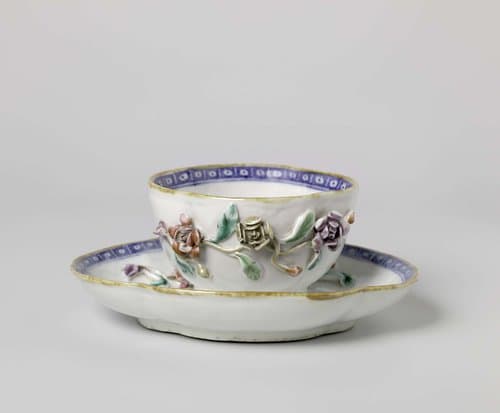
Viermaal gelobde kop en schotel met gemodelleerde bloemtakken
ca. 1750 - ca. 1774
Medium
turning
Dimensions
4.8; 3.9; 8.8; 8.5; 11.8; 4.4; 2.4; 7.2; 7.9; 5.9; 13.9
Rights
Public Domain
About this artwork
Legaat van de heer J.G.A.N. de Vries, Den Haag
Art Historical Context
This delicate cup and saucer, titled *Viermaal gelobde kop en schotel met gemodelleerde bloemtakken* (Four-lobed cup and saucer with modeled flower branches), exemplifies anonymous craftsmanship from the mid-18th century, circa 1750–1774. Standing just 5.9 cm high, its petite scale suggests it was designed for intimate moments, perhaps savoring tea or coffee—a fashionable ritual in Dutch households of the Enlightenment era. The "viermaal gelobde" form refers to its four-lobed shape, a playful Rococo-inspired contour that adds elegance to functionality. Crafted using the turning technique—likely lathe-turning on a potter's wheel—this piece highlights skilled manipulation of clay for precise, symmetrical forms. The gemodelleerde bloemtakken, or modeled flower branches, were hand-applied decorations, showcasing the artisan's dexterity in creating three-dimensional floral motifs that evoke nature's abundance. Such techniques were hallmarks of European ceramics workshops, blending utility with ornamentation. A generous bequest from Mr. J.G.A.N. de Vries of The Hague, this artifact offers a window into 18th-century Dutch material culture, where everyday objects became canvases for subtle artistry. Though anonymous, it reflects the era's thriving pottery traditions, bridging domestic life and aesthetic delight.
About the Artist
anonymous
In the vast tapestry of art history, "Anonymous" stands not as a singular individual but as a collective designation for countless unidentified creators whose works have endured across millennia. These artists, spanning prehistoric cave painters to medieval illuminators and folk craftsmen, produced the foundational layers of human visual culture. Prior to the Renaissance, when individual fame emer...