
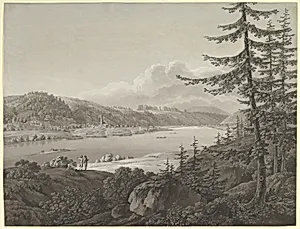
View of Bad Schandau at the River Elbe with the Winterberg
late 18th–early 19th century
Medium
Pen and black ink, brush and gray wash
Dimensions
sheet: 19 3/16 x 25 1/8 in. (48.8 x 63.8 cm)
Classification
Drawings
Department
Drawings and Prints
Museum
Metropolitan Museum of Art, New York, NY
Credit
Van Day Truex Fund, 2006
Accession Number
2006.484
Rights
Public Domain
Tags
Art Historical Context
Adrian Zingg's *View of Bad Schand at the River Elbe the Winterberg* offers a captivating late 18th- to early 19th-century glimpse into the dramatic landscapes of Saxony, Germany. This detailed drawing depicts the quaint town of Bad Schand nestled along the winding Elbe River, with the towering Winterberg rising in the background. Zingg, a Swiss-born who settled in the Leipzig-Dresden region, was renowned for his precise topographical views, blending meticulous observation with a growing Romantic appreciation for nature's grandeur during Europe's Age of Enlightenment. Crafted in pen and black ink with brush and gray wash on a generous sheet (19 3/16 x 25 1/8 in.), the work showcases Zingg's masterful technique. Fine ink lines delineate architecture, foliage, and river currents, while subtle gray washes add atmospheric depth, evoking mist over the water and shadows on the cliffs. This monochromatic palette heightens the scene's serenity and scale, characteristic of the era's veduta tradition—influenced by Italian masters like Canaletto but infused with Germanic precision. Housed in the Metropolitan Museum of Art's Drawings and Prints department (acquired via the Van Day Truex Fund in 2006), this piece highlights the cultural allure of the Elbe Valley, a hub for travelers and artists. It invites us to ponder how such views fueled 19th-century tourism and the Romantic movement's reverence for untamed rivers and mountains.
About the Artist
Adrian Zingg · 1734–1816
Comment on works: Landscape draughtsman; engraver; etcher