
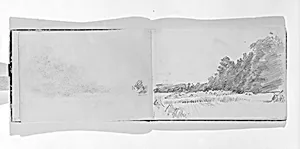
View of Field and Tress (from Sketchbook VII)
Medium
Graphite on off-white wove paper
Dimensions
5 x 7 1/2 in. (12.7 x 19.1 cm)
Classification
Drawing
Culture
American
Department
The American Wing
Museum
Metropolitan Museum of Art, New York, NY
Credit
Purchase, Gifts in memory of Stephen D. Rubin, 1992
Accession Number
1992.2.1a recto
Rights
Public Domain
Tags
Art Historical Context
William Trost Richards, a 19th-century American landscape artist associated with the Hudson River School, captured the serene beauty of the natural world in *View of Field and Treesfrom Sketchbook VII)* dated 1886. This intimate graphite drawing on off-white wove paper reflects Richards' lifelong passion for meticulous nature studies, often created during plein air excursions. At just 5 x 7 1/2 inches, it hails from one of his personal sketchbooks, offering a glimpse into the artist's preparatory process amid the evolving American art scene of the Gilded Age, where realism and close observation celebrated the nation's landscapes. Rendered in graphite—a versatile medium prized for its precision and portability—the delicate lines evoke a tranquil field dotted with trees, showcasing Richards' skill in rendering texture and form with scientific accuracy influenced by Pre-Raphaelite ideals. Wove paper's smooth surface allowed for fine shading and detail, making it ideal for such portable works that informed his larger watercolors and oils. Housed in The Metropolitan Museum of Art's American Wing, this piece underscores the cultural importance of sketchbooks in American art, preserving ephemeral moments that fueled the Romantic reverence for wilderness. Today, it invites visitors to appreciate how Richards' humble sketches bridged intimate observation and grand artistic vision, reminding us of nature's enduring inspiration.
About the Artist
William Trost Richards · 1833–1905
William Trost Richards (1833–1905) was a prominent American landscape and marine painter born in Philadelphia, where he attended Central High School before beginning his artistic training. Between 1850 and 1855, he studied part-time under the German-born Hudson River School artist Paul Weber while working as a designer and illustrator of ornamental metalwork. He exhibited his first works at the Pe...