
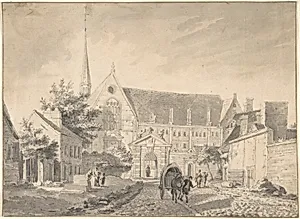
View of the Church of Passy, near Paris
1770
Medium
Pen and black ink and black and gray wash
Dimensions
sheet: 7 x 9 9/16 in. (17.8 x 24.3 cm)
Classification
Drawings
Department
Drawings and Prints
Museum
Metropolitan Museum of Art, New York, NY
Credit
Purchase, Guy Wildenstein Gift, 2004
Accession Number
2004.303
Rights
Public Domain
Tags
Art Historical Context
In 1770, Dutch artist Reinier Vink captured the quaint charm of Passy, a leafy village on the outskirts of Paris, in delicate drawing *View of the Church ofy, near Paris*. during Vinkeles' travels through France as part of the Enlightenment-era fascination with urban and architectural topography, this work depicts a bustling street scene the local church, flanked carriages and everyday life. Passy, now absorbed into modern Paris's 16thondissement, was then a serene retreat for Parisians seeking respite from the city's hustle. Vinkeles, a skilled draftsman and engraver associated with the veduta tradition—detailed views popularized by artists like Canaletto—employed pen and black ink for precise lines, enhanced by black and gray wash to evoke depth, shadow, and atmosphere. This monochromatic technique, common in 18th-century preparatory sketches for prints, allowed for nuanced tonal modeling on a modest 7 x 9 9/16-inch sheet, making it ideal for collectors and scholars studying French vernacular architecture. Today, housed in the Metropolitan Museum of Art's Drawings and Prints department (purchased with the Guy Wildenstein Gift in 2004), this piece offers a window into pre-Revolutionary Paris, blending architectural fidelity with subtle narrative elements like passing carriages, reminding us of the era's blend of rural tranquility and emerging urban energy.