
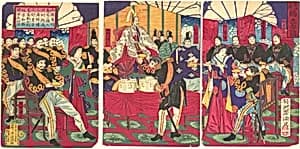
View of the Gift of the Emperor's Gift Cup
Sept. 5, 1877 (Meiji 10)
Medium
One sheet of a triptych of woodblock prints; ink and color on paper
Dimensions
Image (each): 13 7/8 × 9 1/4 in. (35.2 × 23.5 cm) Mat: 23 × 37 in. (58.4 × 94 cm)
Classification
Prints
Culture & Period
Japan · Meiji period (1868–1912)
Department
Asian Art
Museum
Metropolitan Museum of Art, New York, NY
Credit
Gift of Lincoln Kirstein, 1959
Accession Number
JP3222
Rights
Public Domain
Tags
Art Historical Context
This striking woodblock print by Yōshū Chikanobu captures a ceremonial moment from Japan’s Meiji period (1868–1912), when the nation was rapidly modernizing while celebrating its imperial traditions. Created on September 5, 1877, as one panel of a triptych, the work depicts the presentation of the Emperor’s gift cup—an event rich with symbolism of loyalty, hierarchy, and cultural continuity. Figures in elegant attire, including men and women alongside swords and regal personages, suggest a formal gathering that blends courtly ritual with the artist’s keen eye for contemporary detail. Chikanobu, a leading ukiyo-e master of the era, skillfully employed the traditional woodblock technique of ink and color on paper to convey both grandeur and intimacy. The triptych format allowed him to unfold a narrative across multiple sheets, a popular approach for documenting imperial or historical scenes that fascinated Meiji audiences. Though only one sheet survives here, the composition hints at a larger story of reverence and spectacle. Now part of the Metropolitan Museum’s Asian Art collection, this print offers modern viewers a vivid window into Japan’s transition, where age-old artistic methods met new subjects celebrating the emperor and national identity.
About the Artist
Yōshū (Hashimoto) Chikanobu · 1838–1912
Toyohara Chikanobu, born Hashimoto Naoyoshi in 1838 in Echigo Province (modern Niigata Prefecture), emerged as one of the last great ukiyo-e masters during Japan's Meiji era. The son of a low-ranking samurai retainer to the Sakakibara clan, he trained initially in the Kanō school of painting before turning to ukiyo-e printmaking. He studied under a disciple of Keisai Eisen, then joined the studio ...