
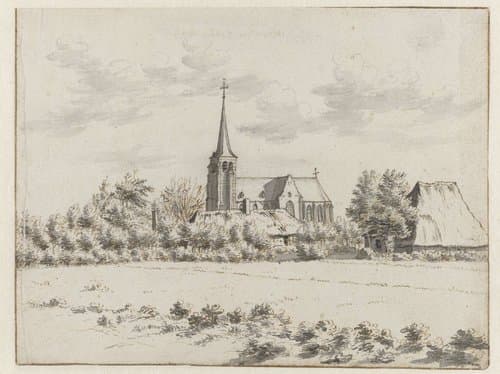
View of the Hamlet of Veerle
1674
Medium
pen and brown ink, with grey wash, over traces of graphite; framing line in brown ink
Dimensions
200; 153
Rights
Public Domain
About this artwork
height 153 mm x width 200 mm
Art Historical Context
"View of the Hamlet of Veerle" offers a charming glimpse into rural life in the late seventeenth century. Created by Barend Klotz in 1674, this modest yet evocative drawing captures the quiet charm of a small settlement, likely in the Low Countries. The scene invites viewers to imagine the daily rhythms of village existence during this period, rendered with a delicate touch that highlights both the landscape and the artist’s observational skill. Klotz employed pen and brown ink with grey wash over faint graphite underdrawing, a technique favored by Dutch and Flemish draftsmen for its ability to convey subtle tonal variations and atmospheric depth. The addition of a brown ink framing line suggests the work was prepared as a finished piece, possibly for inclusion in an album or collection. At just 153 by 200 millimeters, the drawing rewards close viewing, revealing fine details in the architecture and surrounding terrain. As a surviving example of seventeenth-century landscape drawing, the work serves as both an artistic statement and a historical document. Its restrained palette and careful linework reflect the era’s interest in recording the natural and built environment with quiet precision, offering modern audiences a window into how artists of Klotz’s time found beauty in everyday surroundings.