
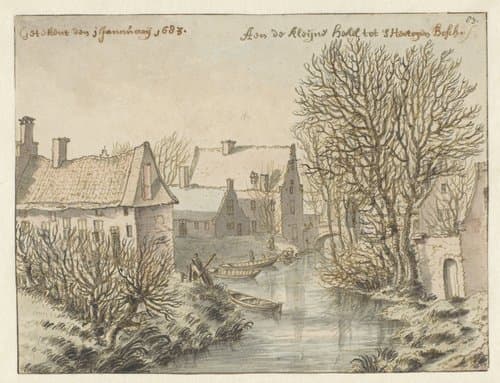
View of the ‘Kleyne Hekel’ in ’s-Hertogenbosch
1683-01-01
Medium
pen and brown, grey and black ink, with grey wash, over traces of graphite; later additions in watercolour; framing line in black ink
Dimensions
152; 199
Rights
Public Domain
About this artwork
pen and brown, grey and black ink, with grey wash, over traces of graphite; later additions in watercolour; framing line in black ink
Art Historical Context
This delicate drawing by Barend Klotz captures a quiet view of the ‘Kleyne Hekel,’ a small lock or drawbridge area in the historic Dutch city of ’s-Hertogenbosch. Created in 1683, the work reflects the Dutch Golden Age interest in topography, where artists documented the built environment with precision and care. The modest scale—only 152 by 199 millimetres—suggests it may have been made as a personal record or for a collector’s album rather than as a large finished painting. Klotz employed pen and brown, grey, and black inks with grey wash over faint graphite lines, a technique that allowed him to build subtle tonal depth and texture. Later additions in watercolour indicate that the sheet was revisited and enhanced, perhaps to heighten its visual appeal for a later owner. The crisp black framing line further shows that the drawing was valued enough to be formally presented. As a topographical view, the work offers modern viewers a glimpse into the everyday urban landscape of a prosperous 17th-century Dutch city. Such drawings helped preserve the appearance of streets, waterways, and fortifications that have since changed, making them both artistic achievements and valuable historical documents.