
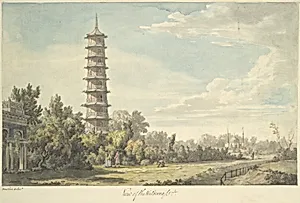
View of the Wilderness at Kew
Medium
Watercolor
Dimensions
Sheet: 11 1/16 x 17 13/16 in. (28.1 x 45.2 cm)
Classification
Drawings
Department
Drawings and Prints
Museum
Metropolitan Museum of Art, New York, NY
Credit
Harris Brisbane Dick Fund, 1925
Accession Number
25.19.43
Rights
Public Domain
Tags
Art Historical Context
This 1763 watercolor captures a serene view of the Wilderness at Kew, part of the Royal Botanic Gardens near London. Created in the medium of watercolor on paper, the work highlights the garden’s winding paths and exotic structures, most notably a striking pagoda rising above the trees. The compact sheet size suggests it may have served as a preparatory study or souvenir for visitors exploring the landscaped grounds. Sir William Chambers, the architect responsible for Kew’s famous ten-story pagoda completed just a year earlier, brought Chinese-inspired design to Georgian England. His collaboration with topographical artist William Marlow reflects the period’s fascination with global influences during Britain’s expanding empire. The scene embodies the Enlightenment-era blend of science, horticulture, and architecture, as Kew became a showcase for rare plants and novel garden follies. Watercolor’s fluid transparency allowed Marlow to evoke the soft English light and lush foliage, making the composition both documentary and atmospheric. Today the piece offers a vivid glimpse into how eighteenth-century audiences encountered the wonders of Kew’s evolving landscape.
About the Artist
Sir William Chambers|William Marlow · 1723–1796
### Sir William Chambers (1723–1796) Born on 23 February 1723 in Gothenburg, Sweden, to parents of Scottish descent—his father a merchant—Sir William Chambers embarked on an extraordinary path that bridged continents and cultures. At just 16, after initial education in England, he joined the Swedish East India Company, undertaking three voyages to China in the 1740s. These journeys profoundly sha...