
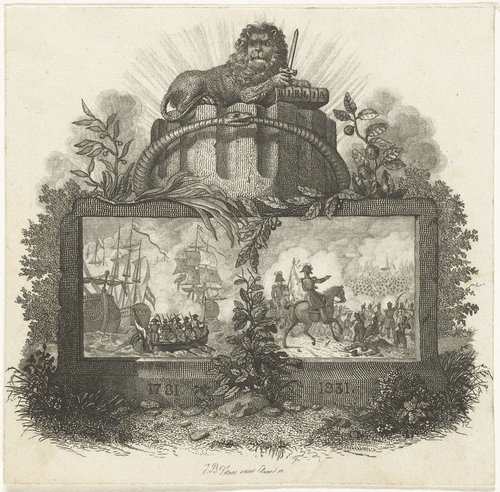
Vignet met allegorie op het tijdvak 1781-1831
1815 - 1889
Medium
engraving
Dimensions
95; 97
Rights
Public Domain
About this artwork
verzamelaarsmerk, verso, gestempeld: Lugt 2228
Art Historical Context
**Vignet met allegorie op hetvak 1781-1831** is a delicate engraving by Jan Baptist Tetar Elven (1815–1889), a Dutch artist renowned for his intricate printmaking. Created as a small vignette—measuring just 95 × 97 mm—this work symbolizes the turbulent era from 1781 to 1831 in Dutch history. This period encompassed the Patriot Revolt against the Orangists, theavian Republic under French influence, Napoleonic rule, and the formation of the United Kingdom of the Netherlands, in the Belgian Revolution of 1830–1831. Tetar van Elven's allegorical design likely captures the political upheaval and national identity struggles through symbolic figures and motifs, typical of 19th-century emblematic art. As an engraving, the piece showcases the precision of intaglio printing, where the artist incised fine lines into a metal plate, inking it and pressing paper to transfer the image. This technique allowed for rich tonal contrasts and exquisite detail in such a compact format, making it ideal for book illustrations or collector's albums. The verso bears a collector's mark (Lugt 2228), linking it to esteemed Dutch print collections, such as those in the Rijksmuseum, underscoring its cultural value. Tetar van Elven's vignette invites reflection on a transformative chapter in the Netherlands' past, blending historical commentary with artistic finesse—a gem for visitors exploring the intersections of politics and printmaking.
About the Artist
Jan Baptist Tetar van Elven · 1805–1879
Jan Baptiste Tetar van Elven (1805–1879) was a Dutch Romantic painter who specialized in meticulously rendered church interiors, a genre with deep roots in Dutch artistic tradition extending back to the seventeenth-century masters Pieter Saenredam and Emanuel de Witte. Working during the nineteenth century when Romanticism's fascination with Gothic architecture and medieval spirituality coincided ...