
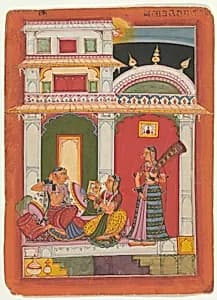
Vilaval Ragini: Folio from a ragamala series (Garland of Musical Modes)
Unknown Artist
ca. 1680
Medium
Ink and opaque watercolor on paper
Dimensions
8 3/4 x 6 3/8 in. (22.2 x 16.2 cm)
Classification
Paintings
Culture
India (Rajasthan, Sirohi)
Department
Asian Art
Museum
Metropolitan Museum of Art, New York, NY
Credit
Gift of Cynthia Hazen Polsky, 1985
Accession Number
1985.398.11
Rights
Public Domain
Tags
Art Historical Context
This delicate folio from a *ragamala* series, created around 1680 in Sirohi, Rajasthan, belongs to a beloved tradition of Indian painting that visually interprets classical musical modes. *Ragamala*, or “Garland of Musical Modes,” pairs each raga or ragini with a poetic scene meant to evoke its distinctive mood, time of day, and emotional resonance. Vilaval Ragini, often associated with longing and self-reflection, is here rendered in the intimate scale typical of Rajasthani court art. Executed in ink and opaque watercolor on paper, the painting showcases the refined techniques of Rajasthan’s miniature tradition—fine brushwork, jewel-like pigments, and careful attention to decorative detail. The presence of mirrors and female figures suggests a moment of quiet introspection, a common visual metaphor in ragamala imagery for the emotional states expressed through music. Such works were treasured in princely collections, where they served both as aesthetic delights and as prompts for musical performance and poetic recitation. Today, this folio offers visitors a window into the rich interplay of sound, poetry, and image that flourished in 17th-century Rajasthan.