
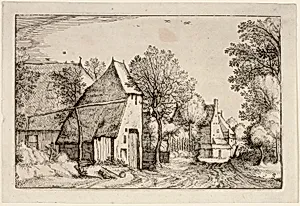
Village Road, plate three after Pictures of Farms, Country Houses and Rustic Villages (Praediorum villarum et rusticarum casularum icones)
Medium
Etching in black on ivory laid paper
Dimensions
Image: 10 × 15.4 cm (3 15/16 × 6 1/8 in.); Plate: 10.2 × 15.6 cm (4 1/16 × 6 3/16 in.); Sheet: 11.6 × 17.1 cm (4 5/8 × 6 3/4 in.)
Classification
etching
Department
Prints and Drawings
Museum
Art Institute of Chicago
Accession Number
40682
Rights
Public Domain
Art Historical Context
Claes Jansz. Visscher II, a leading Dutch engraver and publisher of the early 17th century, created *Village Road* as plate three in his series *Pictures of Farms, Country Houses and Rustic Villages* (Praediorum villarum et rusticarum casularum icones) in 1612. This intimate etching captures the serene charm of rural Dutch life—a winding path flanked by modest thatched cottages, trees, and distant figures—reflecting the growing fascination with everyday landscapes during the Dutch Golden Age's formative years. Etched in black ink on ivory laid paper, the work measures just 10 × 15.4 cm, showcasing Visscher's mastery of the etching technique. Unlike engraving, etching allowed for fluid, spontaneous lines using acid to bite into a wax-grounded copper plate, enabling intricate details in foliage, textures, and atmospheric depth within a compact format. These affordable prints were widely circulated, bringing pastoral scenes to a broad audience beyond elite collectors. Held in the Art Institute of Chicago's Prints and Drawings department, *Village Road* exemplifies the transition from Mannerist ornamentation to naturalistic observation in Northern European art. It presages the celebrated rural idylls of later masters like Rembrandt and Ruisdael, offering a window into the harmonious, prosperous countryside that symbolized Holland's emerging cultural identity amid its Golden Age prosperity.
About the Artist
Claes Jansz. Visscher, II · 1587–1652
Claes Janszoon Visscher II (1587–1652) was one of the most prolific and commercially astute figures of the Dutch Golden Age print world — a draughtsman, etcher, mapmaker, and publisher whose Amsterdam workshop became one of the largest of its kind in Europe. Born into a family already engaged in the print trade, Visscher learned etching and engraving directly from his father, Claes Jansz. Visscher...