
Vitré: The Canal
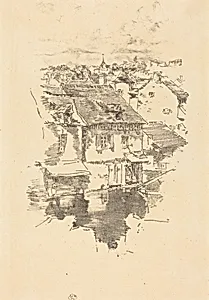
Medium
lithograph in black on laid paper
Dimensions
image: 23.6 × 15.3 cm (9 5/16 × 6 in.) sheet: 33.3 × 21.2 cm (13 1/8 × 8 3/8 in.)
Classification
Department
CG-W
Museum
National Gallery of Art, Washington, D.C.
Credit
Rosenwald Collection
Accession Number
1943.3.8699
Rights
Public Domain
Art Historical Context
James McNeill Whistler’s *Vitré: The Canal (1893) invites visitors into the tranquil waterways of Vitré, a medieval town in Brittany, France. Created as a lithograph in black on laid paper, this intimate print measures just 23.6 × 15.3 cm, capturing the quiet poetry of everyday scenes with Whistler’s signature subtlety. Lithography, a planographic technique Whistler mastered, allowed him to draw directly on stone with greasy crayon, producing velvety tones and fluid lines that mimic the atmospheric haze of his oil paintings. A pioneer of the Aesthetic movement, Whistler prioritized “art for art’s sake,” emphasizing tonal harmony over narrative detail. This work reflects his late-career fascination with Brittany’s architecture and landscapes, produced during a trip where he created an acclaimed series of lithographs. The medium’s accessibility made his refined aesthetic available beyond elite canvases, influencing modern printmakers. Housed in the National Gallery of Art’s Rosenwald Collection, *Vitré: The Canal* exemplifies Whistler’s innovative printmaking, blending precision with evanescent mood. It reminds us how a simple canal could evoke the fleeting beauty of light and shadow.
About the Artist
James McNeill Whistler · 1834–1903
James Abbott McNeill Whistler (1834-1903) was an American-born painter and printmaker who became a leading figure in the Aesthetic Movement and pioneer of Tonalism and Japonisme. He revolutionized art by championing "art for art's sake" and treating paintings as visual equivalents of musical compositions, titling works as "arrangements," "harmonies," and "nocturnes" to emphasize formal qualities o...