
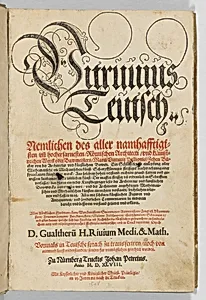
Vitruvius Teutsch nembliuchen des allern namhafftigsten und hocherfarnesten römischen architecti und kunstereichen werck oder bawmeisters, Marci Vitruvij Pollionis zehen bucher von der architectur und künstleichen bawen
Medium
Printed book with woodcut illustrations
Dimensions
11 7/8 x 8 3/8 x 2 3/16 in. (30.2 x 21.2 x 5.5 cm) Box: 12 1/4 x 8 7/8 x 2 7/16 in. (31.1 x 22.6 x 6.2 cm)
Classification
Books|Ornament & Architecture
Department
Drawings and Prints
Museum
Metropolitan Museum of Art, New York, NY
Credit
Bequest of W. Gedney Beatty, 1941
Accession Number
41.100.213
Rights
Public Domain
Art Historical Context
This remarkable 1548 printed book, *Vitruvius Te*, brings the ancient Roman architectural treatise *De Architectura by Marcus Vitruvius Pollio—written around 30–15 BCE—into the German-speaking world. Translated and edited by Gualtherenius Rivius and published by Johann Petre in Nuremberg, it reproduces all ten books on architecture, engineering, and planning. As one of the few surviving texts from antiquity on these subjects, Vitruvi profoundly shaped Renaissance ideals of proportion, symmetry, and utility (firmitas, utilitas, venustas), influencing masters like Alberti and Palladio. This edition made those classical principles accessible beyond Latin scholars, fueling the Northern Renaissance's embrace of humanism and antiquity. What sets this volume apart are its over 200 woodcut illustrations by Nuremberg's finest artists, including Peter Flötner, Georg Pencz, Virgil Solis, Hans Brosamer, Hans Springinklee, and Ludwig Krug. These intricate black-and-white depictions of columns, temples, machines, and ornaments vividly interpret Vitruvius's descriptions, blending technical precision with artistic flair. Woodcuts, a hallmark of 16th-century German printing, allowed for affordable mass production while showcasing the era's mastery of the medium—bold lines and dynamic compositions that brought ancient Rome to life. Housed in the Metropolitan Museum of Art's Drawings and Prints department (bequest of W. Gedney Beatty, 1941), this hefty tome (11⅞ × 8⅜ × 2¼ in.) stands as a cultural bridge, inspiring German architects and craftsmen during a time of rapid urban growth and artistic revival. A true Renaissance treasure!
About the Artist
Georg Pencz|Peter Flötner|Gualther Hermenius Rivius|Marcus Pollio Vitruvius|Virgil Solis|Hans Brosamer|Hans Springinklee|Johann Petreius|Ludwig Krug · 1490–1550
Comment on works: Religious; History; Portraits