
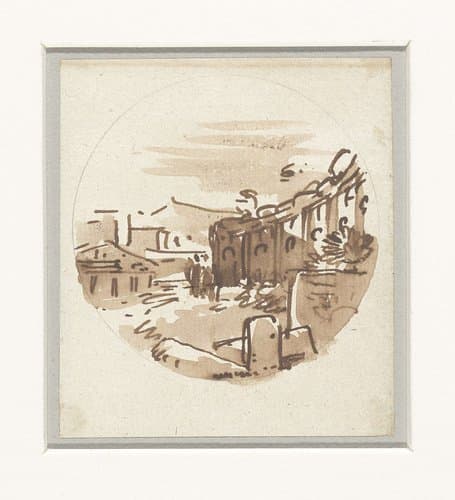
Vluchtige schets van klassieke gebouwen, een tempel en een portiek in een gebogen wand
1787 - 1811
Medium
pen
Dimensions
84; 75
Rights
Public Domain
About this artwork
collector's mark, verso, on the mount, lower centre: Lugt 2228
Art Historical Context
**Vluchtige schets vanieke gebouwen, een temp en een portiek in een gebogen** *Victor Jean Nicolle, 7–1811, pen, 84 × 75 mm* This delicate pen sketch by Victor Jean Nicolle, a architect and draughtsman during the late Enlightenment, captures the essence of neoclassical fascination with ancient architecture. Dated between 1787 and1811—a period bridging the French Revolution and Napoleonic era—the work depicts classical buildings, including a temple and portico set within a curved wall. At just 84 by 75 mm, its intimate scale suggests a "vluchtige schets," or fleeting sketch, likely made on the spot or as a rapid study, reflecting the era's growing archaeological enthusiasm sparked by discoveries at sites like Pompeii and Herculaneum. Nicolle's precise pen lines highlight his architectural expertise, employing quick, economical strokes to convey structure, proportion, and spatial depth—hallmarks of neoclassicism's emphasis on rational harmony inspired by Vitruvius and antiquity. Such sketches were vital tools for architects, serving as memory aids or preparatory designs amid the period's urban expansions and grand public commissions. Verso, on the mount, bears the collector's mark Lugt 2228, linking it to esteemed provenance in European art circles. This tiny gem invites visitors to appreciate the artistry in ephemera, bridging historical reverie with technical mastery.
About the Artist
Victor Jean Nicolle · 1754–1826
Comment on works: Architectural views; Roman views