
Volendam Girl in Costume
1898
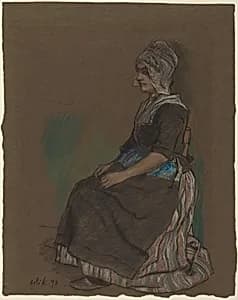
Medium
pastel on gray-brown paper
Dimensions
overall: 36 x 28.6 cm (14 3/16 x 11 1/4 in.)
Classification
Drawing
Department
CG-W
Museum
National Gallery of Art, Washington, D.C.
Credit
Gift of Jill Newhouse and Andrew Robison
Accession Number
2000.90.1
Rights
Public Domain
Art Historical Context
**Volendam Girl in Costume**1898) by Emil Orlik captures the charm of a young woman from Dutch fishing village of Volendam, renowned for its colorful traditional attire. Orlik, an Austrian and printmaker active in Vienna's Secessionist circles, traveled to the Netherlands around this time, drawn to the region's vibrant folk costumes and everyday scenes. This intimate portrait reflects the late 19th-century fascination European artists with picturesque rural life, blending Orlik's keen observation with influences from Japanese woodblock prints that emphasized pattern and color. Executed in pastel on gray-brown toned paper—a medium Orlik favored for its immediacy and luminosity—this 36 x 28.6 cm drawing (14 3/16 x 11 1/4 in.) exploits the paper's subtle hue to heighten contrasts in highlights and shadows. Pastel's soft, blendable strokes bring out the textures of the girl's embroidered costume and the warmth of her expression, showcasing Orlik's skill in graphic arts and portraiture. Now housed in the National Gallery of Art's CG-W Department as a gifted drawing from Jill Newhouse and Andrew Robison, this work offers a window into turn-of-the-century cultural encounters, preserving a fleeting moment of Dutch heritage amid modernism's rise.
About the Artist
Emil Orlik · 1870–1932
Emil Orlík (1870–1932) was a Czech painter, etcher, and lithographer whose cosmopolitan career bridged the artistic centers of Prague, Vienna, Munich, Berlin, and Tokyo. Born on July 21, 1870, in Prague, Orlík became one of the most important promoters of Japanese art and woodcut techniques in early twentieth-century Europe, directly studying traditional Japanese printmaking methods during two ext...