
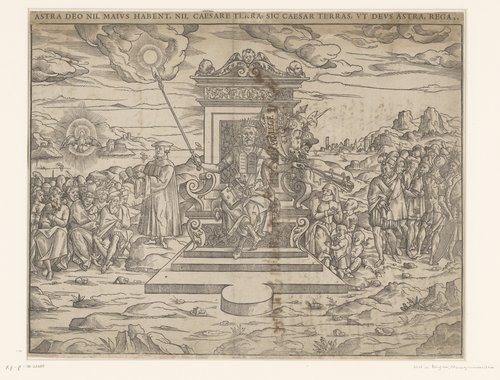
Vorst zittend op een troon
1500 - 1599
Medium
paper
Dimensions
368; 281
Rights
Public Domain
About this artwork
height 281 mm x width 368 mm
Art Historical Context
### Vorst Zittend op een Troon (Prince Seated on a Throne) intriguing 16th-century drawing paper, titled *Vorst Zittend op een Troon* ("Prince Seated on a Throne"), measures a modest 281 mm high by 368 mm wide. Attributed to the enigmatic Monogrammist CR an anonymous German artist active between 1500 and 1599, it captures a regal figure enthroned, evoking the grandeur of Renaissance-era nobility. The use of paper as a medium revolutionary in Northern Europe during this period, allowing for detailed sketches, studies, or preparatory works that could be easily shared among workshops—far more portable and affordable than panel paintings. In the context of late medieval and early Renaissance Germany, such depictions symbolized political power and divine right, amid the Holy Roman Empire's fragmented principalities. The Monogrammist CR's work reflects the era's fascination with portraiture and hierarchy, influenced by masters like Albrecht Dürer, though this piece stands out for its anonymity, hinting at a collaborative or lesser-known atelier tradition. The throne and poised ruler likely served ceremonial or illustrative purposes, perhaps for manuscripts, prints, or courtly commissions. Though details on its exact technique remain sparse, the artwork's survival underscores the value placed on paper-based art in preserving visual records of authority. A quiet testament to German Renaissance ingenuity, it invites visitors to ponder the faces behind the thrones of history. (198 words)