
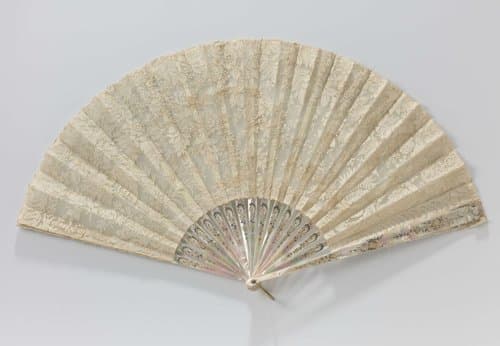
Vouwwaaier met blad van Brussels naaldkant op een montuur van parelmoer voorzien van 'métal en quatre couleurs'
ca. 1865 - ca. 1875
Medium
embroidering
Dimensions
32.8; 33
Rights
Public Domain
About this artwork
geheel: spanwijdte 33 cm x lengte 32,8 cm
Art Historical Context
This exquisite folding fan, titled *Vouwwaaier met blad van Brussels naald op een montuur vanlmoer voorzien vanmétal en quatre'*, dates to around 1865–1875 and exemplifies the opulent craftsmanship of Tiffany & Co., the renowned New York jeweler expanding into luxury accessories during America's Gilded Age. Measuring approximately 33 cm in span and 32.8 cm in length, it features a delicate leaf of Brussels needle lace—a prestigious technique from Belgium where intricate motifs are created stitch by stitch using a needle and fine thread, mimicking the airy transparency of bobbin lace but with unparalleled precision. The fan's mother-of-pearl montuur (guards and sticks) is adorned with *métal en quatre couleurs*, likely intricate metal applications in four hues, adding a shimmering, jewel-like elegance. Brussels needle lace, at its 19th-century peak, was a status symbol worn by European and American elites, requiring months of skilled labor for its floral patterns and gauzy effects. As a fashionable accessory for Victorian women, this fan blended Tiffany's innovative design with traditional European textile artistry, highlighting the era's fusion of technology, trade, and taste. Visitors, imagine unfurling it at a grand ball—its fragility whispers of a bygone world's refined splendor.
About the Artist
Tiffany & Co. · 1837–present
Tiffany & Co., founded on September 18, 1837, by Charles Lewis Tiffany and John B. Young in New York City as a stationery and fancy goods store, quickly evolved into a premier American house for jewelry and decorative arts. Under Charles's leadership, the firm introduced innovations like the sterling silver standard in 1851 and the iconic six-prong Tiffany Setting engagement ring in 1886, establis...