
"Voyons! Mme Majeste..."
1853
Medium
lithograph on chine collé
Dimensions
overall: 37.6 x 32 cm (14 13/16 x 12 5/8 in.)
Classification
Department
CG-E
Museum
National Gallery of Art, Washington, D.C.
Credit
Gift of Frank Anderson Trapp
Accession Number
2002.57.24
Rights
Public Domain
Art Historical Context
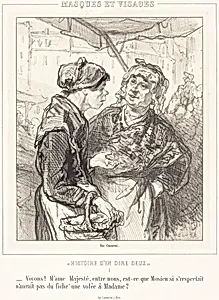
Paul Gavarni's *Voyons! Mme Majeste... (1853) is a lively lithograph on chine collé, capturing the witty social satire for which the French artist was renowned. Gavarni, a master caricaturist active in mid-19th-century Paris the Second Empire, specialized in lithographs that poked fun at bourgeois pretensions, fashion, and theater life. His works, often published in journals like *Le Charivari*, blended sharp observation with fluid lines, making him a key figure in the Romantic-era printmaking revival. This print exemplifies lithography's versatility—a chemical process allowing artists to draw directly on stone for rich tonal effects and mass production—enhanced here by chine collé, where delicate rice paper is mounted on stronger support to preserve intricate details. Measuring 37.6 x 32 cm, its intimate scale suited collectors and the growing market for affordable art. The title, translating roughly to "Come on! Mme Majesty...," hints at mocking haughty elegance, reflecting Gavarni's knack for humanizing high society. Housed in the National Gallery of Art's Prints department (gift of Frank Anderson Trapp), this piece underscores lithography's role in democratizing visual commentary, influencing later illustrators like Daumier and Toulouse-Lautrec. Visitors will appreciate its enduring charm as a window into 1850s Parisian mores.
About the Artist
Paul Gavarni · 1804–1866
Paul Gavarni, born Sulpice Guillaume Chevalier on January 13, 1804, in Paris to a cooper father from Burgundy and mother Marie-Monique Thiémet—whose brother, painter Guillaume Thiémet, served as his godfather—began his career far from the art world. As a youth, he worked in a machine factory and studied mechanical drawing at the Conservatoire des Arts et Métiers in 1818, followed by evening classe...