
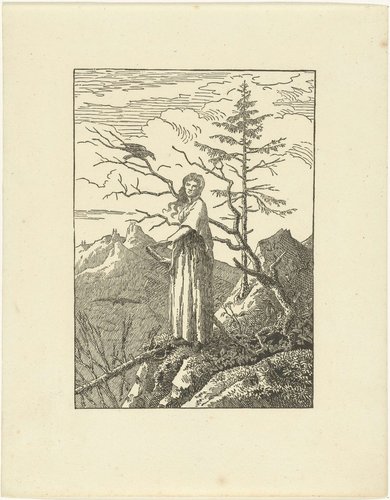
Vrouw staand aan de rand van de afgrond en raaf
1801 - 1803
Medium
paper
Dimensions
119; 168; 245; 192
Rights
Public Domain
About this artwork
houtsnede
Art Historical Context
Caspar David Friedrich's *Vrouw staand aan rand van de afgrond raaf* (Woman Standing at the Edge of the and Raven), created between 1801 and1803, captures the early essence of German Romanticism in a intimate woodcut on paper measuring just 168 × 119 mm. This-scale print depicts a solitary woman poised perilously at a chasm's edge, accompanied by a ominous raven—a motif evoking isolation, the sublime power of nature, and existential contemplation, hallmarks of Friedrich's visionary style. As one of Friedrich's earliest works, it foreshadows his later monumental oil paintings, like *Wanderer above the Sea of Fog*, by blending human fragility with nature's vast, unforgiving drama. Emerging during the Napoleonic era's turmoil, Romanticism rebelled against Enlightenment rationalism, prioritizing emotion and the spiritual in art. Friedrich, a pioneer of this movement, often used symbolic figures to explore themes of mortality and transcendence. The woodcut medium, or *houtsnede*, underscores its technical innovation: carved into wood blocks and printed, it allowed broader dissemination of bold, graphic imagery. This piece invites viewers to ponder the abyss—not just literal, but metaphorical—reminding us of nature's awe-inspiring terror and beauty in a format perfect for quiet reflection.
About the Artist
Caspar David Friedrich · 1774–1840
Leading artist of the German Romantic movement. He was particularly known for his symbolic and atmospheric treatment of landscape.