
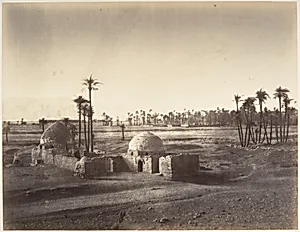
Vue de la Plaine de Thèbes prise du temple de Karnac
1867
Medium
Albumen silver print from paper negative
Dimensions
Image: 32 × 41.5 cm (12 5/8 × 16 5/16 in.) Mount: 19 13/16 × 25 9/16 in. (50.3 × 65 cm)
Classification
Photographs
Department
Photographs
Museum
Metropolitan Museum of Art, New York, NY
Credit
Gilman Collection, Gift of The Howard Gilman Foundation, 2005
Accession Number
2005.100.679
Rights
Public Domain
Tags
Art Historical Context
Step into the sun-drenched vastness of ancient Egypt with Gustave Le Gray's *Vue de la Plaine Thèbes prise du de Karnac* (1867), an albumen silver print capturing the sweeping Plain of Thebes from the iconic Temple of Karn. Le Gray, a pioneering French and teacher at the École des Beaux-Arts, to Egypt late in his career, using his lens to immortalize the monumental ruins that symbolized humanity's ancient grandeur. This 32 × 41.5 cm image, mounted on a larger 50.3 × 65 cm sheet, draws viewers into a timeless landscape of crumbling columns and endless horizons. Printed from a paper negative—a technique Le Gray helped refine for achieving sharp detail and expansive scale in outdoor scenes—the photograph exemplifies mid-19th-century advancements in photography. Albumen silver prints, coated with egg whites for luminous tones, were ideal for documenting archaeological wonders amid Europe's growing fascination with Egyptology. Taken during a period of French expeditions to the Nile Valley, it bridges art and science, preserving Karnak's majestic scale for posterity. Now in the Metropolitan Museum of Art's Gilman Collection, this work highlights photography's role in cultural heritage, inviting us to ponder the endurance of pharaonic legacy against the modern gaze. A testament to Le Gray's mastery, it transforms ruins into poetry.
About the Artist
Gustave Le Gray · 1820–1884
Gustave Le Gray, born on August 30, 1820, in Villiers-le-Bel near Paris to a prosperous merchant family, pursued his artistic ambitions against his parents' wishes for a legal career. As an only child, he trained as a painter in the studios of François-Édouard Picot and Paul Delaroche at the École des Beaux-Arts, exhibiting at the Paris Salons in 1848 and 1853. In 1844, he married Palmira Leonardi...