
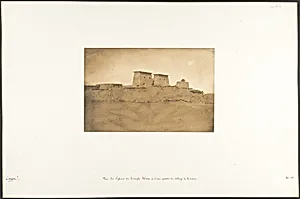
Vue des Pylones du Temple Khons et d'une partie du village de Karnac
May 6, 1850
Medium
Salted paper print from paper negative
Dimensions
Image: 5 1/4 × 8 1/8 in. (13.4 × 20.6 cm) Mount: 12 5/16 × 18 11/16 in. (31.2 × 47.5 cm) Frame: 16 x 20 in. (40.6 x 50.8 cm)
Classification
Photographs
Department
Photographs
Museum
Metropolitan Museum of Art, New York, NY
Credit
Gilman Collection, Gift of The Howard Gilman Foundation, 2005
Accession Number
2005.100.376.53
Rights
Public Domain
Tags
Art Historical Context
Step into ancient Egypt through Maxime Du Camp's *Vue des Pylones Temple Khons et d partie du village de Karn*, a salted paper print captured on May 6, 1850. This intimate 5¼ × 8⅛-inch image frames the towering pylons of the Khonsu at Karnak—one of the largest religious complexes in the world—alongside a glimpse of the nearby village. Du Camp, a pioneering French photographer and writer, documented these majestic ruins during his 1849–1850 travels, offering visitors a rare window into pharaonic grandeur amid everyday life. Printed from a paper negative using the calotype process, this photograph exemplifies early 19th-century innovation. The salted paper technique, refined by William Henry Fox Talbot, produced soft, textured tones that beautifully render the weathered stone textures and dramatic shadows of the temple's massive gateways. Unlike daguerreotypes, calotypes allowed multiple prints, making Du Camp's Egyptian series—published in his 1852 album *Egypte, Nubie, Palestine et Syrie*—widely accessible and influential in popularizing photography of antiquities. As part of The Met's Gilman Collection, this work highlights photography's role in preserving cultural heritage. It captures Karnak's timeless allure, where Ptolemaic-era pylons (built around 237–88 BCE) stand as testaments to ancient devotion to the moon god Khonsu, blending architectural splendor with the human scale of village life. A must-see for lovers of history and early photo artistry!
About the Artist
Maxime Du Camp · 1822–present
Maxime Du Camp (1822–1894) was a pioneering French photographer and writer whose adventurous spirit and technical innovation bridged literature and visual art during the mid-19th century. Born in Paris on February 8, 1822, to a prosperous family—his father a successful surgeon—Du Camp received a solid bourgeois education at the Collège Bourbon (now Lycée Condorcet), where he cultivated interests i...