
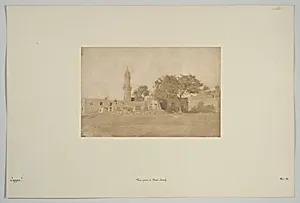
Vue prise à Béni-Souef
February 19, 1850
Medium
Salted paper print from paper negative
Dimensions
Image: 5 3/4 × 8 7/8 in. (14.6 × 22.6 cm) Mount: 12 5/16 × 18 11/16 in. (31.2 × 47.5 cm) Frame: 16 x 20 in. (40.6 x 50.8 cm)
Classification
Photographs
Department
Photographs
Museum
Metropolitan Museum of Art, New York, NY
Credit
Gilman Collection, Gift of The Howard Gilman Foundation, 2005
Accession Number
2005.100.376.22
Rights
Public Domain
Tags
Art Historical Context
Maxime Du Camp's *Vue prise à Béni-Sef*, dated February 19, 0, captures a serene architectural vista in Beni Suef, Egypt, showcasing towers and buildings that evoke the region's timeless allure. As a pioneering French photographer and writer, Du Camp documented his travels through Egypt and the Near East during an 1849–1851 expedition alongside Gustave Flaubert. This salted paper print reflects the dawn of photography as a tool for exploration, preserving scenes that blended ancient heritage with everyday life. Printed from a paper negative—a hallmark of the calotype process invented by William Henry Fox Talbot—this medium produced soft, tonal images with subtle gradations, ideal for atmospheric landscapes. Unlike crisp daguerreotypes, the paper negative allowed multiple prints, making Du Camp's work accessible and influential. At 5 3/4 × 8 7/8 inches, its intimate scale draws viewers into the intricate details of Egyptian architecture, from sturdy towers to sunlit facades. Housed in the Metropolitan Museum of Art's Gilman Collection, this photograph underscores photography's role in 19th-century Orientalism, bridging Western curiosity with Eastern cultural landmarks. A testament to early technical innovation, it invites us to ponder how a single image can freeze history in salt and silver.
About the Artist
Maxime Du Camp · 1822–present
Maxime Du Camp (1822–1894) was a pioneering French photographer and writer whose adventurous spirit and technical innovation bridged literature and visual art during the mid-19th century. Born in Paris on February 8, 1822, to a prosperous family—his father a successful surgeon—Du Camp received a solid bourgeois education at the Collège Bourbon (now Lycée Condorcet), where he cultivated interests i...