
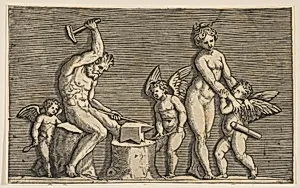
Vulcan seated hammering on an anvil flanked by Venus and three cupids
ca. 1515–27
Medium
Engraving
Dimensions
Sheet (Trimmed): 4 1/4 × 6 7/8 in. (10.8 × 17.4 cm)
Classification
Prints
Department
Drawings and Prints
Museum
Metropolitan Museum of Art, New York, NY
Credit
The Elisha Whittelsey Collection, The Elisha Whittelsey Fund, 1959
Accession Number
59.570.295
Rights
Public Domain
Tags
Art Historical Context
In the heart of the Renaissance, Marco Dente, a skilled Italian engraver active in Rome around 1515–27, crafted this enchanting *Vulcan Seated Hammering on an Anvil Flanked by and Three Cupids*. a master of engraving—an intaglio printmaking technique where intricate lines are incised into a metal plate with a burin—Dente detailed, reproducible images that brought classical mythology to a wider audience. This small sheet (4 1/4 × 6 7/8 in.), now in the Metropolitan Museum of Art's Drawings and Prints department, exemplifies the period's revival of antique themes, likely inspired by designs from Raphael's circle. The scene bursts with divine energy: Vulcan, the Roman god of fire and forge, hunches intently at his anvil, hammer raised mid-strike, embodying the nobility of craftsmanship. Flanking him are his wife, the radiant Venus, goddess of love, and three playful cupids, symbols of desire and mischief. This tableau draws from Ovid's tales, evoking Vulcan's tumultuous marriage to Venus—famed for her affairs—while celebrating the harmony of labor and beauty in Renaissance humanism. Dente's precise linework captures texture and movement, from Vulcan's muscular form to the cupids' fluttering wings, making engravings like this vital for disseminating High Renaissance ideals. A gem from The Elisha Whittelsey Collection, it invites us to ponder how gods mirrored human passions and the artisan's divine spark.
About the Artist
Marco Dente · 1515–1527
Marco Dente (died 1527), also known as Marco da Ravenna, was among the most accomplished printmakers working in Rome during the High Renaissance, a period that witnessed an extraordinary flowering of engraving as both a reproductive and an independent artistic medium. Little is known of his early training, but by the second decade of the sixteenth century he had established himself in the orbit of...