
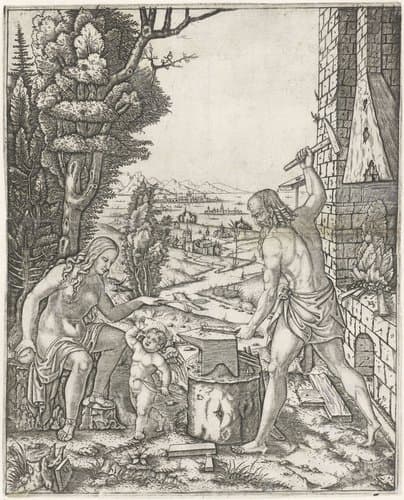
Vulcanus smeedt pijlen en vleugels voor Amor in aanwezigheid van Venus
1510 - 1527
Medium
engraving
Dimensions
207; 258
Rights
Public Domain
About this artwork
Bruikleen van de gemeente Amsterdam
Art Historical Context
**Vulcanus smeedt pijlen en vleugels voor Amor in aanwezigheid van Venus** Marcantonio Raimondi 1510–1527, Engraving, 258 × 207 mm* *(On loan from the Municipality of)* This enchanting engraving by Marcantonio Raimondi a whimsical moment from classical mythology: Vulcan, the god of fire and metalworking, forges arrows and wings for the mischievous Amor (Cupid) while Venus, goddess of love, looks on. Created during the Renaissance (1510–1527), it reflects the era's fascination with ancient Roman tales, revived through humanism and rediscovered antiquities. Raimondi, a master Italian engraver from Bologna, often reproduced designs by Raphael, and this work likely draws from one of the artist's compositions, blending precise linework with dynamic figures to evoke the High Renaissance ideal of harmony and grace. Raimondi's engraving technique revolutionized printmaking, using intricate copperplate burin strokes to achieve unprecedented detail and tonal depth—far surpassing earlier woodcuts. At 258 × 207 mm, this intimate sheet allowed wide dissemination of elite art, making Raphael's vision accessible to collectors across Europe. Its survival as a loan from Amsterdam's municipality highlights its enduring cultural treasure status, bridging antiquity and the dawn of modern graphic arts in a visitor-friendly format.
About the Artist
Marcantonio Raimondi · 1475–1534
Marcantonio Raimondi (c. 1480–1534), born near Bologna, Italy, emerged as one of the Renaissance's premier engravers, revolutionizing printmaking through his mastery of reproductive techniques. He trained in the workshop of the goldsmith, painter, and niellist Francesco Francia, whose influence is evident in his early engravings, such as the goldsmith-like shading in *Pyramus and Thisbe* (1505), h...