
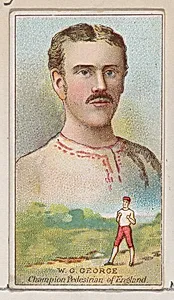
W.G. George, Champion Pedestrian of England, from the Champions of Games and Sports series (N184, Type 2) issued by W.S. Kimball & Co.
Medium
Commercial color lithograph
Dimensions
Sheet: 2 11/16 × 1 1/2 in. (6.8 × 3.8 cm)
Classification
Prints|Ephemera
Department
Drawings and Prints
Museum
Metropolitan Museum of Art, New York, NY
Credit
The Jefferson R. Burdick Collection, Gift of Jefferson R. Burdick
Accession Number
63.350.216.184.29
Rights
Public Domain
Tags
Art Historical Context
Step into the vibrant world of 19th sports memorabilia with this petite commercial color lithograph,W.G. George, Pedestrian of England*, from the *Champions of Games and Sports* seriesN184, Type 2), issued by W.S. & Co. in 1887. Measuring just 2 11/16 × 1 1/2 inches, this tiny print captures the poised figure of William George, a celebrated English athlete renowned for his prowess in pedestrianism—a grueling professional walking sport that enthralled Victorian audiences with endurance races spanning miles. Produced as ephemera, likely a collectible insert in cigarette packages, the card exemplifies chromolithography's revolutionary role in mass-producing vivid, affordable color images. Kimball & Co., a tobacco firm, leveraged such series to promote their products while fueling the era's obsession with athletic heroes, blending commerce with cultural fandom. Pedestrianism, peaking in the 1870s-80s, symbolized British grit and physical supremacy amid industrialization. Today, housed in The Metropolitan Museum of Art's Jefferson R. Burdick Collection, this artifact offers a window into how everyday objects immortalized sports icons, bridging art, advertising, and popular culture. A delightful glimpse of history in your palm!
About the Artist
W.S. Kimball & Co.
William S. Kimball & Co. was a tobacco manufacturer based in Rochester, New York, whose influence extended well beyond the cigarette trade into the realm of popular visual culture. Founded in 1846 by William S. Kimball and James C. Hart, the company grew into one of the largest tobacco concerns in the United States, erecting a landmark factory along the Erie Canal on Court Street in 1880. The buil...