
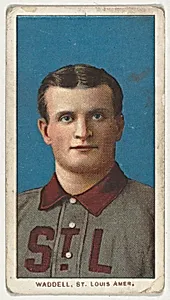
Waddell, St. Louis, American League, from the White Border series (T206) for the American Tobacco Company
1909–11
Medium
Commercial lithograph
Dimensions
Sheet: 2 5/8 x 1 7/16 in. (6.7 x 3.7 cm)
Classification
Prints|Ephemera
Department
Drawings and Prints
Museum
Metropolitan Museum of Art, New York, NY
Credit
The Jefferson R. Burdick Collection, Gift of Jefferson R. Burdick
Accession Number
63.350.246.206.169
Rights
Public Domain
Tags
Art Historical Context
Step into the golden age of baseball with this charming lithograph from the American Tobacco Company's legendary T206 White Border series produced between 1909 and 1911. Featuring Rubeaddell, the flamboyant star pitcher for the St. Browns of the American League, this portrait (just 2⅝ × 1⅞ inches) captures the athletic hero in a clean, white-bordered design that became iconic among early 20th-century collectors As a commercial lithograph, it exemplifies mass-produced printing techniques that allowed vibrant color halftones to bring sports figures to life on everyday cigarette pack inserts. These cards were more than mere promotions; they fueled America's burgeoning baseball craze and hobbyist collecting culture. The T206 set, one of the most celebrated tobacco card issues, boasted over 500 players and sparked lifelong passions—today, rarities like the Honus Wagner card fetch millions. Donated to The Metropolitan Museum of Art through Jefferson R. Burdick's vast collection, this Waddell example highlights how ephemera bridged art, commerce, and sport, preserving portraits of athletes who defined an era. Though modest in scale, its cultural footprint is immense, evoking nostalgia for a time when tobacco tins doubled as treasure chests for fans young and old.
About the Artist
American Tobacco Company · 1826–1909
**American Tobacco Company (1890–1911)** Founded on January 31, 1890, in Durham, North Carolina, by James Buchanan Duke, the American Tobacco Company emerged from the consolidation of five major U.S. tobacco manufacturers: W. Duke & Sons, Allen & Ginter, Goodwin & Company, W.S. Kimball & Co., and Kinney Brothers. Under Duke's aggressive leadership, it rapidly achieved monopoly status, controlling...