
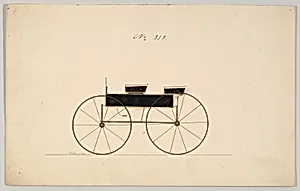
Wagon #313
ca. 1865
Medium
Pen and black ink, watercolor and guache, with gum arabic and metallic ink
Dimensions
sheet: 6 1/16 x 9 11/16 in. (15.4 x 24.6 cm)
Classification
Drawings
Department
Drawings and Prints
Museum
Metropolitan Museum of Art, New York, NY
Credit
Gift of William Brewster, 1923
Accession Number
23.112.1960
Rights
Public Domain
Tags
Art Historical Context
Step into the elegant world of 19th coachmaking with *Wagon #313*, a meticulously rendered design drawing from around 1865 by John W. Britton for the prestigious New York firm Brewster & Co. This piece captures the refined lines of a horse-drawn wagon, likely part of a catalog or proposal showcasing the company's expertise in crafting luxury carriages for America's elite. Produced in the post-Civil War era, reflects a booming carriage industry that symbolized status and innovation just before the automobile's rise. Crafted on a modest sheet measuring 6 1/16 x 9 11/16 inches, the artwork employs pen and black ink for precise outlines, enhanced by watercolor and gouache for depth and color. Gum arabic adds a glossy sheen, while metallic ink highlights metallic accents, mimicking the gleam of polished hardware. These techniques blend technical draftsmanship with artistic allure, making complex mechanical details visually compelling and aiding manufacturers in visualization and sales. Today, this gem in the Metropolitan Museum of Art's Drawings and Prints department—gifted by William Brewster in 1923—offers a window into an era of handcrafted mobility. It celebrates the unsung artistry behind everyday transport, reminding us how design elevated function to fashion.
About the Artist
Brewster & Co.|John W. Britton · 1837–present
**Brewster & Co.** Brewster & Company, a premier American coachbuilder renowned for its exquisite carriage designs, was established in 1810 in New Haven, Connecticut, by James Brewster (1788–1866). Born in 1788, Brewster trained as a wagonmaker's apprentice starting at age 16 in Northampton, Massachusetts, before relocating to New Haven, where he set up his workshop and quickly gained acclaim for...