
Walrus, from the Animals of the World series (T180), issued by Abdul Cigarettes
1881
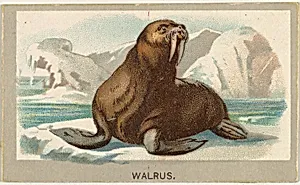
Medium
Commercial color lithograph
Dimensions
Sheet: 1 5/8 × 2 3/4 in. (4.2 × 7 cm)
Classification
Prints|Ephemera
Department
Drawings and Prints
Museum
Metropolitan Museum of Art, New York, NY
Credit
The Jefferson R. Burdick Collection, Gift of Jefferson R. Burdick
Accession Number
63.350.246.180.31
Rights
Public Domain
Tags
Art Historical Context
Step into the whimsical world of 19th ephemera with *Walrus, from the Animals of the World series (T180)*, a tiny commercial color lithograph issued by Abdul Cigarettes in 1. Measuring just 1 5/8 × 2 3/4 inches, this pocket-sized print was tucked into cigarette packs as a collectible incentive, sparking a craze for trading cards among smokers and children alike. Part of a broader series showcasing global wildlife, it reflects the era's fascination with exotic animals, blending education and entertainment in an age before widespread photography. Chromolithography, the medium here, was a breakthrough in mass printing, allowing vibrant, multi-layered colors to be produced affordably on a commercial scale. This technique brought the walrus's bulky form and tusks to life with striking detail, making distant creatures accessible to everyday audiences. Issued by Abdul Cigarettes—likely evoking an exotic, Turkish-inspired brand—the card exemplifies how tobacco companies marketed their products through cultural curiosities. Today, preserved in The Metropolitan Museum of Art's Jefferson R. Burdick Collection, this ephemera highlights the artistry of everyday objects. It reminds us how such humble prints fueled collecting hobbies that evolved into serious scholarship, preserving glimpses of Victorian-era wonder.
About the Artist
Abdul Cigarettes · 1881–1881
Abdul Cigarettes, an enigmatic American entity active solely in 1881, stands as a fascinating footnote in the history of commercial art, best known for producing vibrant chromolithograph trade cards inserted into cigarette packages as promotional inserts. Little is documented about its origins or personnel, suggesting it operated as a short-lived publishing venture rather than the work of a singul...