
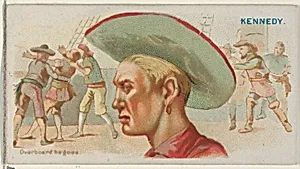
Walter Kennedy, Overboard He Goes, from the Pirates of the Spanish Main series (N19) for Allen & Ginter Cigarettes
Medium
Commercial color lithograph
Dimensions
Sheet: 1 1/2 x 2 3/4 in. (3.8 x 7 cm)
Classification
Prints|Ephemera
Department
Drawings and Prints
Museum
Metropolitan Museum of Art, New York, NY
Credit
The Jefferson R. Burdick Collection, Gift of Jefferson R. Burdick
Accession Number
63.350.201.19.46
Rights
Public Domain
Tags
Art Historical Context
Step into the swashbuckling world of 19th-century piracy with *Walter Kennedy, Overboard He Goes*, a vibrant card from Allen & Ginter's *Pirates of the Spanish* series (N19), issued around 1888. This tiny commercial color lithograph captures the dramatic moment of a pirate's fate, featuring the infamous Walter Kennedy— a real historical figure tried for piracy in 1716—in profile, evoking the high-seas adventure that captivated Victorian imaginations. Produced by George S. Harris & Sons, these cards were tucked into cigarette packs as collectibles, turning everyday tobacco into a gateway for storytelling and education. Allen & Ginter pioneered these promotional inserts in the 1880s, sparking a collecting craze among adults and children alike, with series on sports, actors, and rogues like pirates fueling America's early pop culture obsession. The *Spanish Main* theme romanticized Caribbean buccaneers, blending fact with folklore to glamorize outlaws amid the era's naval reforms. At just 1½ x 2¾ inches, this ephemera exemplifies chromolithography's magic—layered color printing that brought bold hues and crisp details to mass-produced art, making luxury visuals accessible. Today, housed in the Metropolitan Museum of Art's Jefferson R. Burdick Collection, it highlights how commercial prints democratized history and heroism, preserving pirate lore in a format as fleeting as smoke. A pocket-sized portal to adventure!
About the Artist
Allen & Ginter|George S. Harris & Sons
Allen & Ginter, the pioneering American tobacco firm based in Richmond, Virginia, emerged around 1880 from the partnership of John F. Allen and Lewis Ginter, evolving from Allen's earlier John F. Allen & Company. Allen retired in 1882, succeeded by John Pope, yet the brand endured under Ginter's leadership, employing over 1,100 workers—mostly women—for hand-rolled cigarettes by 1886. Ginter, a Dut...