
BK-15772-B
c. 1797 - c. 1803
Medium
silver (metal)
Dimensions
14
Rights
Public Domain
About this artwork
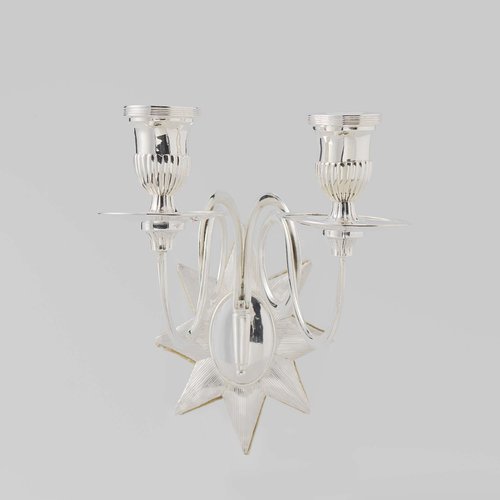
Dubbele wandarm van zilver. De ovale kaarsenhouder met vetvanger zit aan een lusvormig geslingerde arm. De twee armen komen in het zelfde punt uit, op een stervormige wandplaat.
Art Historical Context
This elegant silver double wall sconce, titled *BK-15772-B*, crafted by Dutch silversmith Bernardus van Haaps around 1797–1803, exemplifies the refined metalwork of the late Dutch Republic and early Batavian era. Standing at a modest 14 cm high, it features two gracefully twisted, loop-shaped arms that converge at a striking star-shaped wall plate. Each arm supports an oval candle holder equipped with a practical drip pan (vetvanger), blending functionality with decorative flair for illuminating interiors. Van Haaps, a skilled artisan likely working in a tradition of Dutch silver guilds, employed sophisticated techniques such as twisting and forming to create the fluid, sling-like arms, showcasing the era's mastery of repoussé and chasing on precious metal. Silver was a status symbol for affluent households, often used in parlors or hallways to cast a warm, flickering glow during evening gatherings. Historically, such sconces bridged Rococo exuberance and emerging Neoclassical restraint, reflecting post-Revolutionary Europe's taste for symmetrical, star motifs symbolizing enlightenment. This piece offers a glimpse into everyday luxury, where light fixtures doubled as sculptural art, enhancing the ambiance of 18th-century Dutch homes.