
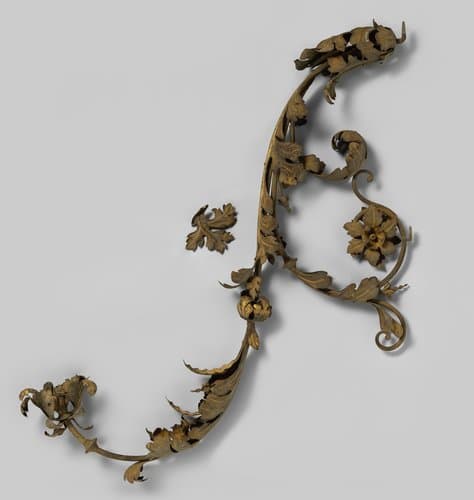
Wandarm in vorm bebladerde rank, uit verz. Mannheimer.
Unknown Artist
1700
Medium
gild
Dimensions
140
Rights
Public Domain
About this artwork
Een verguld ijzeren wandarm. Gevormd door een lange, naar boven gerichte, met bladeren bezette rank die aan het einde ombuigt en na een nodus in een bloem eindigt. Even onder het midden ontspruit een tweede zich naar de wand buigende rank met voor het midden een schijfvormige nodus. Deze rank met terugbuigend zijrank, is bezet met bladeren en eindigt in een bloem. Afkomstig uit de verzameling Dr. F. Mannheimer.
Art Historical Context
This exquisite gilded iron wall arm, to 1700, the ornate metalwork of the early 18th century. Titled *Wandarm in vormbladerde rank, verz. Mannheimer*, takes the graceful form of a long,-curving vine adorned with leaves. The central stem bends elegantly at the top, culminating in a flower after a subtle node, while a secondary branch extends toward the wall, featuring a disc-shaped node, more leaves, a recurving side shoot, and another blooming flower. Standing at 140 cm tall, its intricate design transforms a functional sconce—likely for candles or torches—into a sculptural delight. Crafted from iron and lavishly gilded for a luminous, jewel-like sheen, the piece highlights the technical prowess of anonymous artisans in manipulating metal into organic, flowing shapes. Such nature-inspired motifs, evoking abundance and vitality, were hallmarks of Baroque decorative arts, blending utility with opulent fantasy in grand European interiors. Provenance adds luster: it hails from the renowned collection of Dr. F. Mannheimer, a 20th-century banker whose trove of masterworks now graces institutions like the Rijksmuseum. This wall arm invites visitors to appreciate how everyday objects became statements of elegance and craftsmanship in the Age of Ornament.