
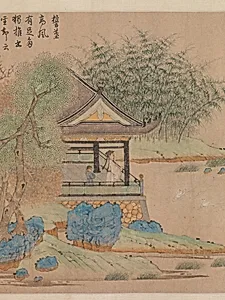
元 錢選 王羲之觀鵝圖 卷|Wang Xizhi watching geese
ca. 1295
Medium
Handscroll; ink, color, and gold on paper
Dimensions
Image: 9 1/8 x 36 1/2 in. (23.2 x 92.7 cm) Overall with mounting: 11 x 418 13/16 in. (27.9 x 1063.8 cm)
Classification
Paintings
Culture & Period
China · Yuan dynasty (1271–1368)
Department
Asian Art
Museum
Metropolitan Museum of Art, New York, NY
Credit
Ex coll.: C. C. Wang Family, Gift of The Dillon Fund, 1973
Accession Number
1973.120.6
Rights
Public Domain
Tags
Art Historical Context
In the tranquil elegance of Qian Xuan's *Wang Xizhi Watching Ge* (ca. 1295), a Yuan dynasty (1271–1368) handscroll masterpiece, we encounter the legendary Eastern Jin calligrapher Wang Xhi, China's "Sage of Calligraphy." The scene captures a serene moment inspired by a famous anecdote: Wang, mesmerized by the graceful movements geese in a Zhejiang pond, sought to acquire them to study their fluid forms, ultimately refining his iconic cursive script. Rendered in ink, color, and gold on paper (9 1/8 x 36 1/2 in.), this work evokes the literati ideal of harmony between nature and artistic inspiration amid pavilions and scholarly figures. Qian Xuan, a scholar-painter who bridged Song orthodoxy with Yuan sensibilities under Mongol rule, masterfully employs the handscroll format—measuring over 35 feet when fully unrolled—for an intimate, sequential viewing experience. His delicate brushwork blends precise ink outlines with subtle colors and shimmering gold, highlighting the geese's lively postures against misty landscapes. This technique reflects Yuan artists' revival of classical styles, emphasizing moral and aesthetic refinement over imperial pomp. Housed in the Metropolitan Museum of Art's Asian Art collection (gift of The Dillon Fund, 1973), this scroll celebrates enduring Chinese cultural values: the interplay of observation, nature, and creativity. A poetic reminder that true mastery flows from quiet contemplation.