
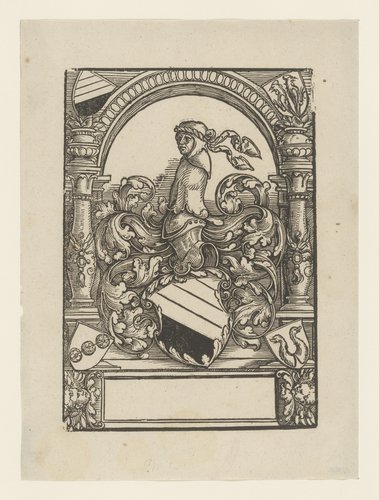
Wapenschild van de familie Pömer
1510 - 1550
Medium
paper
Dimensions
160; 112
Rights
Public Domain
About this artwork
blad: hoogte 160 mm x breedte 112 mm
Art Historical Context
**Wapenschild van familie Pömer** This delicate work, titled *Wapenschild van familie Pömer* (Coat of Arms of Pömer Family), a small-scale artwork on paper measuring just 160 mm high by 112 mm wide. Attributed to the anonymous hand of Hans Sebald Be or his circle, it dates to the Renaissance period between 1510 and 1550. Beham, one of the renowned "Little Masters" of German printmaking, specialized in intricate engravings and woodcuts, often capturing heraldic motifs like family crests that symbolized lineage, status, and identity in early modern Europe. Heraldry flourished during the Renaissance as noble families commissioned such emblems for seals, banners, and personal items, reflecting social hierarchies and regional pride—likely tied here to a German or Central European lineage. The modest paper medium was ideal for Beham's precise technique, allowing fine details in lines and shading that could be reproduced affordably, making elite symbols accessible to a broader audience through prints. Though anonymous in execution, its attribution to Beham highlights the era's mastery of miniature forms, blending Gothic precision with emerging Renaissance naturalism. This charming artifact invites us to ponder the Pömer family's storied past, preserved in a single sheet of history. (198 words)