
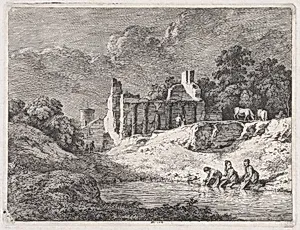
Washerwomen
Medium
Etching; second state of four
Dimensions
Sheet: 6 1/4 × 7 13/16 in. (15.8 × 19.9 cm) Plate: 4 3/4 × 6 5/16 in. (12.1 × 16 cm)
Classification
Prints
Department
Drawings and Prints
Museum
Metropolitan Museum of Art, New York, NY
Credit
Gift of James David Draper, 2000
Accession Number
2000.361.7
Rights
Public Domain
Tags
Art Historical Context
Jean-Jacques de Boissieu's *Washerwomen* (1773) is a delicate etching from the second state four, capturing a serene rural scene in late 18th-century France Measuring just 6 1/4 × 7 13/16 inches, this intimate print belongs to the Metropolitan Museum of's Drawings and Prints collection, gifted in 2000. De Boissieu, a-based artist and master etcher influenced by Rembrandt, excelled in pastoral vignettes that romanticize everyday life amid the Lyonnaise countryside. The composition evokes quiet industry: women washerwomen at labor by a stream, surrounded by grazing cows and weathered ruins that hint at antiquity's gentle decay. Etching's fine lines and tonal gradations allow Boissieu to render textures—from rippling water to soft foliage—with remarkable subtlety, a technique honed through multiple states that refined the image's depth and atmosphere. This work reflects the Rococo-era fascination with nature and humble pursuits, bridging aristocratic elegance with emerging Romantic sensibilities just before the French Revolution. A charming window into pre-industrial tranquility, it invites viewers to linger on the harmony of human endeavor and landscape.
About the Artist
Jean Jacques de Boissieu · 1736–1810
French, Lyons 1736–1810 Lyons