
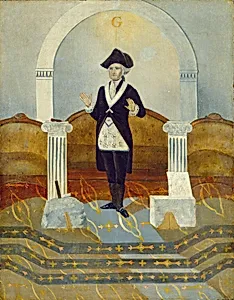
Washington, the Mason
c. 1868
Medium
oil on canvas
Dimensions
overall: 38.4 x 30.5 cm (15 1/8 x 12 in.) framed: 46.3 x 38.1 x 3.4 cm (18 1/4 x 15 x 1 5/16 in.)
Classification
Painting
Department
CAB
Museum
National Gallery of Art, Washington, D.C.
Credit
Gift of Edgar William and Bernice Chrysler Garbisch
Accession Number
1956.13.12
Rights
Public Domain
Art Historical Context
Created around 1868 by an unidentified American artist, *Washington, the Mason* is a compact oil-on-canvas portrait that reflects the enduring national fascination with George Washington in the decades following the Civil War. The title points to Washington’s well-documented role as a Freemason, a fraternal whose ideals of brotherhood, moral virtue, and civic duty resonated strongly in nineteenth-century America. At just over fifteen inches tall, the work likely served as a private devotional image or study rather than a large public commission. Painted in oil on canvas, the medium allowed the artist to achieve subtle tonal gradations and a sense of dignified presence within a modest format. Such small-scale portraits were popular during this period for their accessibility and intimate viewing experience. Gifted to the National Gallery of Art by Edgar William and Bernice Chrysler Garbisch, the painting now offers visitors a window into how later generations continued to celebrate Washington not only as a revolutionary leader but also as a symbol of moral and civic ideals.
About the Artist
American 19th Century · 1800–1900
The artist cataloged as "American, 19th Century" represents a collective of unidentified painters active in the United States during the nineteenth century, with 380 known artworks preserved in this virtual museum's collection. These works span a diverse array of genres typical of the era, including portraits, landscapes, still lifes, and genre scenes, reflecting the burgeoning artistic output of ...