
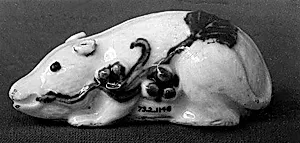
Water Bottle in the Form of a Mouse
Unknown Artist
18th century
Medium
White porcelain decorated with blue under the glaze (Hirado ware)
Dimensions
H. 1 1/4 in. (3.2 cm); L. 3 3/8 in. (8.6 cm)
Classification
Ceramics
Culture & Period
Japan · Edo period (1615–1868)
Department
Asian Art
Museum
Metropolitan Museum of Art, New York, NY
Credit
Purchase by subscription, 1879
Accession Number
79.2.1146
Rights
Public Domain
Tags
Art Historical Context
This delightful *Water Bottle in the Form of a Mouse exemplifies the whimsical artistry of 18th-century Japanese Hirado ware, a prized porcelain from the kilns on Hirado Island during the Edo period (1615–1868). Crafted from fine white porcelain and decorated with intricate blue underglaze designs before firing, this tiny vessel measures just 1¼ inches high and 3⅜ inches long—perfectly sized for practical use likely as a water dropper for ink painting or calligraphy. The mouse form captures the playful naturalism favored in Japanese ceramics of the era, blending functionality with charm. Hirado ware gained fame for its technical mastery, producing translucent bodies and vivid cobalt-blue motifs that resisted fading, often inspired by Chinese prototypes but infused with Japanese ingenuity. Produced for both domestic elites and export markets, these pieces highlight the Edo period's flourishing ceramic industry amid Japan's isolationist policies. Acquired by the Metropolitan Museum of Art through a public subscription in 1879, this rare survivor showcases the era's innovative mold-making and glazing techniques. Mice, as a motif, add a touch of endearing humor, reflecting Japan's appreciation for everyday creatures in art. A true gem of Asian ceramics, it invites visitors to marvel at how such miniature masterpieces bridged utility and beauty in Edo Japan.