
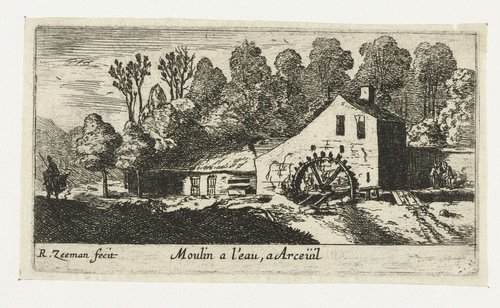
Watermolen bij Arceuil
1650
Medium
etching
Dimensions
120; 66
Rights
Public Domain
About this artwork
verzamelaarsmerk, recto rechtsonder, gestempeld: Lugt 1967
Art Historical Context
**Watermolen bijceuil** is a delicate etching by Reinier Nooms, a prominent Dutch artist of the Golden Age active in the mid-17th century Created around 1650, this print measures just 66 mm high by 120 mm wide, showcasing Nooms' skill in capturing everyday landscapes. Known also as Zeeman for his maritime scenes, Nooms often turned his eye to topographical views, blending precise observation with a lively sense of atmosphere. Here, the watermill near Arcueil—a suburb south of Paris—evokes the serene rural life of 17th-century France, possibly from Nooms' travels or studies abroad. Etching, Nooms' favored medium, allowed for intricate lines etched into a metal plate with acid, producing rich tonal variations ideal for small-scale works like this. During the Dutch Golden Age, such prints were prized by collectors for their affordability and detail, democratizing art beyond paintings. This technique highlights Nooms' mastery in rendering water's flow and architectural textures with economical strokes. Adding to its allure, the print bears a collector's mark stamped on the lower right recto (Lugt 1967), referencing Frits Lugt's catalog of ownership stamps. This provenance links it to esteemed historical collections, underscoring its enduring value as a window into 17th-century European vistas. Visitors, imagine holding this tiny treasure— a testament to printmaking's quiet revolution!
About the Artist
Reinier Nooms · 1613–1664
Comment on works: Marines; View