
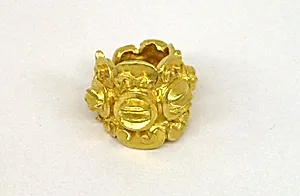
Weighted Fastener
Unknown Artist
Second half of the 8th–second half of the 10th century
Medium
Gold
Dimensions
H. 3/16 in. (0.5 cm); Diam. 5/8 in. (1.6 cm)
Classification
Jewelry
Culture & Period
Indonesia (Java) · Central Javanese period
Department
Asian Art
Museum
Metropolitan Museum of Art, New York, NY
Credit
The Samuel Eilenberg-Jonathan P. Rosen Collection of Indonesian Gold, Bequest of Samuel Eilenberg and Gift of Jonathan P. Rosen, 1998
Accession Number
1998.544.153
Rights
Public Domain
Art Historical Context
Nestled in the opulent world of ancient Java, this *Weighted Fastener* is a delicate masterpiece of gold jewelry from Indonesia's Central Javanese (second half of the 8th–second half the 10th century Measuring just 3/16 inch high and 5/8 inch in diameter, this tiny artifact—crafted entirely from gold—likely served as a clasp or weight to secure garments or headdresses, blending utility with luxury. Its petite scale highlights the extraordinary finesse of Javanese goldsmiths, who worked with precious metal to create status symbols for the elite. During the Central Javanese era, powerful Hindu-Buddhist kingdoms like the Sailendras and Matarams flourished, erecting monumental temples such as Borobudur and Prambanan. Gold objects like this one were rare treasures, often found in royal burials or temple offerings, symbolizing wealth, divine favor, and spiritual power. The use of pure gold underscores advanced metallurgical techniques, including hammering and possibly soldering, which allowed for such intricate, enduring forms despite the object's diminutive size. Today, this fastener graces the Metropolitan Museum of Art's Asian Art collection, part of The Samuel Eilenberg-Jonathan P. Rosen Collection of Indonesian Gold (1998). It offers a glimpse into the refined artistry of a golden age, reminding us how even the smallest adornments carried profound cultural weight in ancient Java.